
An Internal Developer Platform acts as a control plane between developers and infrastructure, defining how systems are consumed, not just provisioned.
Most organizations adopt Kubernetes to standardize infrastructure, but end up standardizing complexity instead. Each team builds its own deployment patterns, defines its own pipelines, and encodes its own operational assumptions. The system scales technically, but fragments operationally. This is where the need for an Internal Developer Platform stops being optional and becomes structural.
The core problem is not infrastructure orchestration. It is the lack of a stable interface between developers and the systems they depend on. Kubernetes provides powerful primitives, but no opinion on how they should be consumed. Backstage centralizes visibility, but does not enforce consistency by default. Without a unifying layer, teams are left to translate infrastructure into workflows on their own, and that translation becomes the real bottleneck.
Most attempts to solve this fail because they focus on assembling tools instead of designing a platform. They introduce templates, scripts, and dashboards, but do not define clear boundaries, ownership models, or lifecycle contracts. As a result, the platform becomes another source of divergence rather than a mechanism for alignment. This is why simply adding Backstage on top of Kubernetes rarely changes developer experience in a meaningful way.
An Internal Developer Platform changes the problem by redefining how infrastructure is exposed. It introduces a controlled surface where capabilities are abstracted, standardized, and versioned. This aligns with the shift toward platform engineering as a discipline, where internal platforms are treated as products with users, interfaces, and guarantees, rather than collections of tools.
In this article, we will break down how to build an Internal Developer Platform with Kubernetes and Backstage as a cohesive system. The focus is not on installing components, but on defining the architecture that connects them: how the platform acts as a control plane, how responsibilities are partitioned, and how tradeoffs emerge as the system evolves across teams and environments.
What an Internal Developer Platform Actually Is
The Internal Developer Platform as a Control Plane
An Internal Developer Platform is often described as a collection of tools, but that framing is fundamentally incorrect. At a system level, an Internal Developer Platform acts as a control plane that governs how developers interact with infrastructure, not the infrastructure itself. It defines the contracts, abstractions, and workflows that sit between intent and execution.
This distinction matters because it shifts the platform from being an implementation detail to being an architectural boundary. Kubernetes already operates as a control plane for containers, but it does not define how teams should deploy services, manage environments, or enforce operational standards. The Internal Developer Platform sits above Kubernetes, translating organizational rules into consumable interfaces.
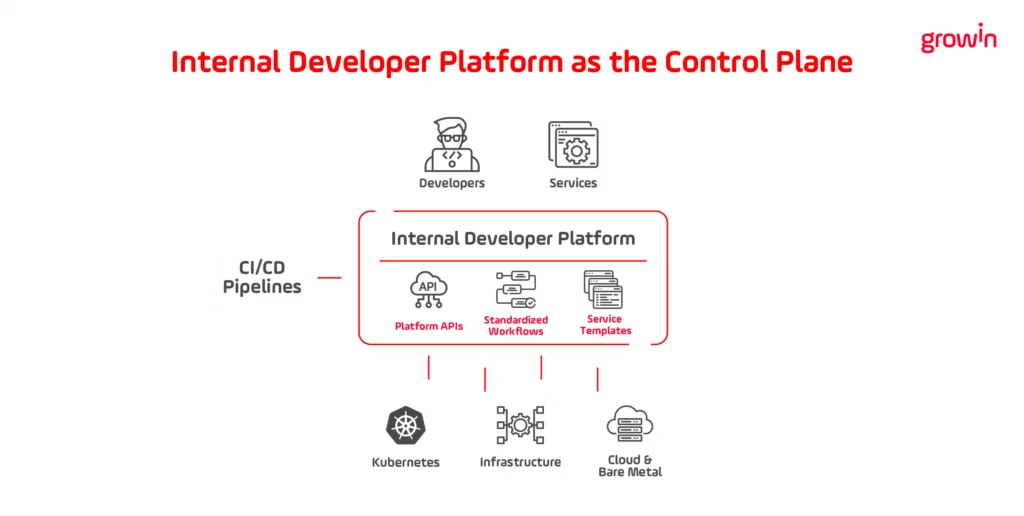
This model makes it clear that the Internal Developer Platform does not sit within the delivery flow, but instead governs how that flow is defined, executed, and standardized across teams.
The tradeoff here is between flexibility and coherence. Without a control plane, teams retain full autonomy but introduce divergence. With an Internal Developer Platform, you enforce consistency but must carefully design abstractions to avoid over-constraining teams. This is why poorly designed platforms often get bypassed—they encode decisions too early or too rigidly. This model aligns with how Kubernetes itself is structured, where declarative APIs define desired state and controllers reconcile reality. An Internal Developer Platform extends that idea to the organizational level.
Interfaces Over Infrastructure
Most teams think in terms of infrastructure resources: clusters, namespaces, pipelines, secrets. An Internal Developer Platform forces a different perspective. It defines interfaces that represent capabilities, such as deploying a service, provisioning a database, or exposing an API, without exposing the underlying mechanics directly.
This is where Backstage becomes relevant, but not sufficient. Backstage provides a surface for discovering services and triggering workflows, yet it does not define what those workflows should enforce. The Internal Developer Platform must define those workflows as stable, versioned interfaces, turning infrastructure operations into platform APIs.
The architectural implication is that infrastructure becomes an implementation detail behind the platform interface. This reduces cognitive load for developers, but introduces responsibility for platform teams to maintain backward compatibility and versioning strategies. Breaking a platform interface has a wider impact than changing a Terraform module, because it affects every consuming team.
The tradeoff is clear: abstraction reduces friction but increases coupling to the platform. This is why interface design becomes one of the most critical aspects of an Internal Developer Platform. For a deeper understanding of how Backstage structures service metadata and interfaces, the official documentation provides a useful reference point.
Platforms as Products, Not Projects
An Internal Developer Platform cannot be approached as a one-time initiative. It behaves as a product with users, feedback loops, and evolving requirements. Treating it as a project leads to static architectures that degrade over time as teams outgrow initial assumptions.
The shift to a product mindset introduces new system dynamics. Platform teams must prioritize developer experience, define service-level expectations, and measure adoption as a signal of success. This is fundamentally different from infrastructure teams, where success is often measured in uptime and cost efficiency.
The non-obvious implication is that the platform must compete with ad hoc solutions. If developers can achieve their goals faster outside the platform, they will bypass it. This creates a continuous pressure to refine interfaces, reduce friction, and align with real workflows rather than theoretical models.
The tradeoff here is between control and adoption. Strong governance improves consistency but risks reducing usability. High usability increases adoption but may weaken enforcement. An effective Internal Developer Platform continuously balances these forces.
Breaking Down the Internal Developer Platform into System Layers
The Developer Interaction Layer
At the top of the system, the Internal Developer Platform exposes an interaction layer where developers define intent rather than implementation. This is where actions like deploying a service, creating an API, or provisioning a dependency are initiated, typically through Backstage, CLI tools, or declarative configuration.
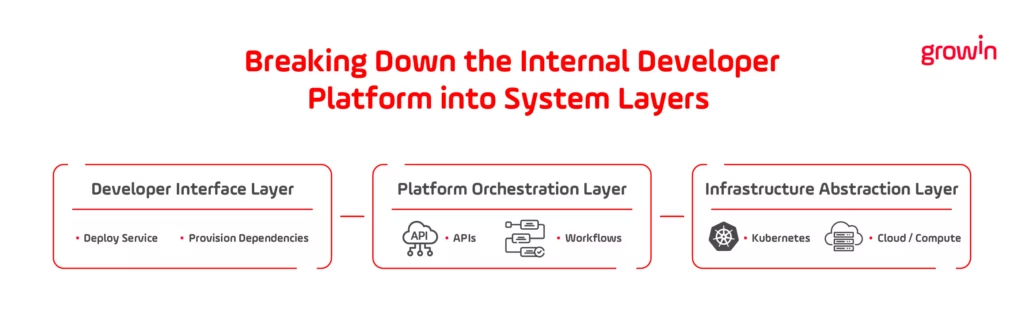
This layered structure makes it clear that each part of the Internal Developer Platform has a distinct responsibility, and that confusion between layers is often the root cause of platform complexity and failure.
What matters here is not the interface itself, but the contract it enforces. A well-designed Internal Developer Platform ensures that every interaction maps to a standardized workflow, preventing teams from bypassing critical steps such as security checks, environment configuration, or observability setup. The interface becomes a gatekeeper for consistency.
The tradeoff is that abstraction must remain aligned with real developer workflows. If the interaction layer introduces friction or fails to support edge cases, teams will revert to direct infrastructure access. This creates a shadow system outside the platform, undermining its purpose. The challenge is to design interfaces that are restrictive enough to enforce standards, yet flexible enough to support variation. This approach mirrors how Backstage structures developer portals around software templates and actions, allowing teams to trigger platform workflows through a controlled surface.
The Platform Orchestration Layer
Beneath the interaction layer sits the orchestration core of the Internal Developer Platform. This is where workflows, APIs, and automation logic translate developer intent into executable operations across systems. It is the layer that connects CI/CD pipelines, infrastructure provisioning, and deployment logic into a coherent flow.
This layer is where Kubernetes and Backstage begin to intersect. Backstage triggers workflows, but the orchestration layer defines how those workflows execute, often through pipeline engines, GitOps controllers, or custom APIs. Kubernetes then acts as the execution environment for workloads, but not as the orchestrator of developer intent.
The architectural implication is that orchestration must be deterministic and observable. If workflows behave inconsistently or lack visibility, debugging becomes a cross-system problem that is difficult to resolve. This is a common failure mode when orchestration logic is fragmented across multiple tools without a clear ownership boundary.
The tradeoff is between centralization and extensibility. A highly centralized orchestration layer simplifies governance but limits customization. A more extensible model allows teams to define variations but risks divergence. The Internal Developer Platform must balance these forces by defining core workflows while allowing controlled extension points. This aligns with GitOps principles, where declarative definitions and reconciliation loops ensure consistent system state across environments.
The Infrastructure Abstraction Layer
At the base of the system, the Internal Developer Platform abstracts the underlying infrastructure, including Kubernetes clusters, cloud services, and supporting resources such as databases and networking components. This layer is responsible for executing the operations defined by the orchestration layer.
The key here is that infrastructure is not exposed directly to developers. Instead, it is wrapped behind platform APIs that define what can be provisioned and how. Kubernetes plays a central role by providing a consistent execution model, but it remains an implementation detail from the developer’s perspective. This abstraction introduces a critical architectural shift. Instead of teams managing infrastructure configurations directly, they rely on platform-defined capabilities. This reduces cognitive load and improves consistency, but also introduces dependency on the platform team’s ability to maintain and evolve these abstractions.
The failure scenario emerges when abstraction leaks. If developers need to understand Kubernetes internals to debug issues or work around limitations, the platform has failed to provide a sufficient interface. Conversely, over-abstraction can limit flexibility, preventing teams from optimizing for specific use cases.
The Internal Developer Platform must continuously adjust this boundary, exposing enough detail to remain usable while hiding enough complexity to remain scalable. For a deeper understanding of Kubernetes as an abstraction layer for workloads, the official documentation provides a useful reference.
How Kubernetes and Backstage Fit into the Internal Developer Platform
An Internal Developer Platform connects multiple systems through a control plane, coordinating workflows, infrastructure, and delivery pipelines.
Kubernetes as the Execution Substrate
Kubernetes is often mistaken as the foundation of an Internal Developer Platform, but in reality, it operates at a lower level. Within the system, Kubernetes acts as the execution substrate where workloads run, resources are scheduled, and desired state is enforced.
This distinction is critical because Kubernetes does not define how applications should be deployed within an organization. It provides primitives such as Pods, Deployments, and Services, but leaves the responsibility of structuring workflows and enforcing standards to higher layers. The Internal Developer Platform consumes Kubernetes as an implementation layer rather than exposing it directly.
The tradeoff is between control and abstraction. Exposing Kubernetes directly gives teams flexibility but increases cognitive load and inconsistency. Abstracting it through the Internal Developer Platform reduces variability but requires the platform team to encode deployment patterns, scaling rules, and operational constraints. If these abstractions are poorly designed, developers are forced to bypass them and interact with Kubernetes directly, breaking the platform model. This reflects the intended role of Kubernetes as described in its architecture, where it manages state reconciliation rather than developer workflows.
Backstage as the Interaction Surface
Backstage plays a fundamentally different role within an Internal Developer Platform. It does not orchestrate infrastructure or execute workloads. Instead, it provides the interaction surface where developers discover services, trigger workflows, and interact with the platform.
This makes Backstage the entry point into the system, but not the system itself. It aggregates metadata, exposes templates, and provides visibility into service ownership and status. However, without a well-defined Internal Developer Platform behind it, Backstage becomes a passive catalog rather than an active control layer.
The architectural implication is that Backstage must remain decoupled from execution logic. It should trigger platform APIs and workflows, not implement them. When organizations embed too much logic into Backstage plugins, they blur the boundary between interface and orchestration, making the system harder to evolve.
The tradeoff is between convenience and separation of concerns. Embedding logic into the interface simplifies initial implementation but creates long-term rigidity. Keeping Backstage thin preserves flexibility but requires stronger platform APIs underneath. This aligns with how Backstage is positioned as a developer portal rather than a platform engine.
The Internal Developer Platform as the Coordination Layer
Between Kubernetes and Backstage sits the actual Internal Developer Platform. This is the layer that translates developer intent into system behavior, coordinating pipelines, infrastructure provisioning, and deployment logic.
This coordination layer is where most of the complexity lives. It integrates CI/CD systems, Git repositories, infrastructure APIs, and runtime environments into a unified workflow. The Internal Developer Platform defines how these systems interact, ensuring that deployments follow consistent patterns and that infrastructure changes are governed by platform rules.
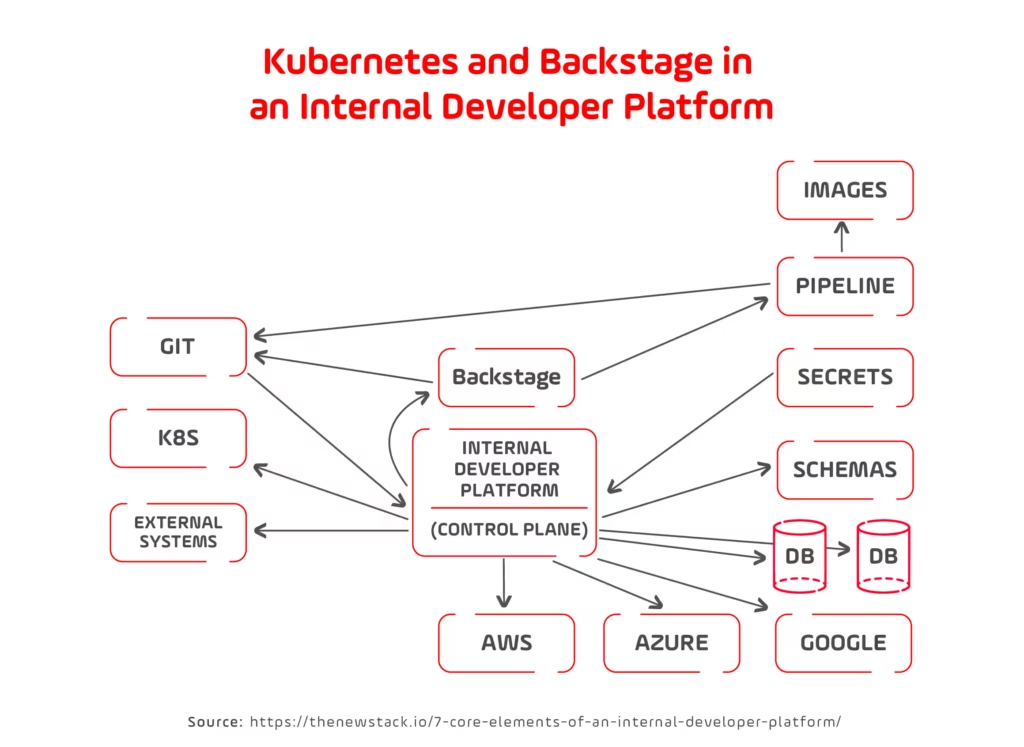
This perspective makes it clear that Kubernetes and Backstage are not standalone solutions, but components whose value emerges only when they are connected and governed through the Internal Developer Platform.
The non-obvious insight is that this layer must remain invisible to most developers. Its success is measured not by how visible it is, but by how effectively it reduces friction. Developers should experience a simplified interface, while the platform handles orchestration behind the scenes.
The failure mode occurs when this coordination layer becomes fragmented. If pipelines, infrastructure logic, and deployment workflows are managed independently, the Internal Developer Platform loses its ability to enforce consistency. Instead of a unified system, it becomes a loose collection of integrations.
The tradeoff is between central orchestration and distributed ownership. A centralized platform ensures consistency but may limit team autonomy. A distributed model allows flexibility but risks divergence. The Internal Developer Platform must define clear extension points to balance these concerns. This layered interaction model reflects broader platform engineering practices, where internal platforms unify multiple systems under a single operational model.
Integrate Kubernetes and Backstage at the Right Boundaries
Kubernetes and Backstage should be integrated into the Internal Developer Platform based on their roles, not their popularity. Kubernetes operates as the execution layer, while Backstage acts as the interaction surface. The platform connects them through APIs and workflows.
Backstage should trigger platform workflows through templates and actions, not implement deployment logic directly. Kubernetes should execute workloads and enforce state, not define how applications are deployed organizationally. The Internal Developer Platform defines the contract between these layers. The failure mode occurs when these boundaries are blurred. Embedding orchestration logic in Backstage creates tight coupling between interface and execution. Exposing Kubernetes directly to developers bypasses platform controls, leading to inconsistency.
The platform must maintain clear separation to remain scalable. The tradeoff is between convenience and correctness. Tight integration may simplify initial setup, but weakens architectural clarity. Proper separation requires more upfront design, but results in a more adaptable system. This separation reflects how Backstage is intended to integrate with external systems through plugins and APIs rather than acting as an orchestration engine.
Scaling the Internal Developer Platform Across Teams and Environments
Scaling an Internal Developer Platform is not about adding features, but about extending control without increasing complexity.
From Single Team Enablement to Organizational System
An Internal Developer Platform often begins as a solution for a single team or a small group of services. At this stage, assumptions are implicit, workflows are loosely enforced, and platform decisions are shaped by immediate needs. As adoption grows, these assumptions break down. What worked for one team becomes a constraint for many.
Scaling an Internal Developer Platform requires a shift from local optimization to organizational design. The platform must evolve from enabling individual teams to coordinating multiple teams with different requirements, maturity levels, and risk profiles. This introduces the need for clearly defined contracts, versioned interfaces, and governance models that can operate across boundaries.
The tradeoff is between speed and alignment. Early-stage platforms prioritize speed of delivery, often at the cost of consistency. At scale, inconsistency becomes a systemic risk, forcing the Internal Developer Platform to enforce stronger standards. This transition is where many platforms fail, as they attempt to retrofit governance onto systems that were not designed for it. This reflects broader platform engineering practices, where internal platforms evolve into organizational systems rather than team-specific tools.
Managing Multi-Environment Complexity
As the Internal Developer Platform expands, environments multiply. Development, staging, testing, and production are no longer isolated concerns but interconnected systems that must be managed consistently. Each environment introduces variations in configuration, access control, and operational requirements.
The Internal Developer Platform must define how environments are created, configured, and promoted. This includes standardizing environment lifecycles, enforcing deployment policies, and ensuring that changes propagate predictably. Without this control, environment drift becomes inevitable, leading to inconsistencies between testing and production systems.
The non-obvious challenge is that environments are not just technical constructs—they encode organizational processes. Approval flows, compliance requirements, and release strategies are all tied to how environments are structured. The Internal Developer Platform must integrate these concerns without exposing unnecessary complexity to developers.
The tradeoff is between isolation and efficiency. Highly isolated environments improve safety but increase cost and operational overhead. Shared environments reduce cost but introduce risk of interference. The Internal Developer Platform must balance these concerns by defining clear boundaries and usage patterns. For a deeper view on environment management in Kubernetes-based systems, this aligns with how namespaces and cluster segmentation are used to isolate workloads.
Governance Without Friction
As the Internal Developer Platform scales, governance becomes unavoidable. Security policies, compliance requirements, and operational standards must be enforced consistently across teams. However, heavy-handed governance can slow down development and reduce platform adoption.
The Internal Developer Platform must embed governance into its workflows rather than applying it externally. This means integrating policy checks, approval mechanisms, and validation steps directly into platform APIs and automation pipelines. Developers should experience governance as part of the system, not as an additional process.
The failure mode occurs when governance is treated as a separate layer. External approval processes, manual checks, and disconnected tools create friction and encourage teams to bypass the platform. In contrast, integrated governance ensures that compliance is achieved without disrupting developer workflows.
The tradeoff is between control and usability. Strong governance improves reliability and security but risks increasing complexity. High usability improves adoption but may weaken enforcement. The Internal Developer Platform must continuously adjust this balance as organizational needs evolve. This approach aligns with policy-as-code practices, where governance is embedded directly into system workflows.
Evolving the Platform as a Product
At scale, the Internal Developer Platform must be treated as a continuously evolving product. New requirements emerge, existing workflows need refinement, and platform capabilities must adapt to changing technologies and organizational structures.
This introduces the need for feedback loops, usage metrics, and iterative development. Platform teams must understand how the Internal Developer Platform is used, where friction occurs, and which features drive adoption. Without this feedback, the platform risks diverging from real developer needs.
The non-obvious implication is that success is not measured by feature completeness, but by adoption and effectiveness. A smaller, well-designed Internal Developer Platform that is widely used is more valuable than a feature-rich system that teams avoid. This requires prioritizing developer experience alongside technical robustness. The tradeoff is between stability and evolution. Frequent changes improve adaptability but may introduce instability. Strong stability improves reliability but may slow down innovation. The Internal Developer Platform must manage this tension through versioning, backward compatibility, and controlled rollout strategies.
Internal Developer Platforms as an Organizational Shift
An Internal Developer Platform is often introduced as a way to improve developer productivity, but its real impact is structural. It changes how organizations define ownership, how systems are exposed, and how teams interact with infrastructure. What begins as a technical solution evolves into an organizational model.
Without an Internal Developer Platform, complexity grows organically. Each team builds its own abstractions, defines its own workflows, and manages its own operational concerns. This creates local efficiency but global inconsistency. Over time, the system becomes harder to reason about, and coordination becomes the limiting factor.
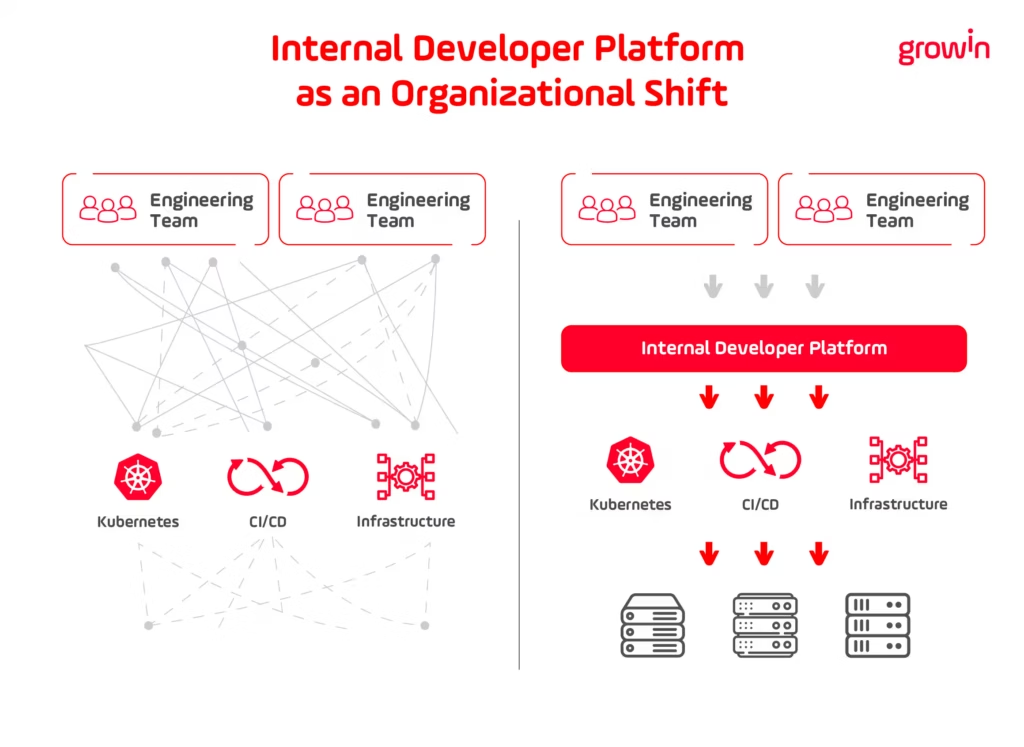
An Internal Developer Platform reverses this dynamic by centralizing how capabilities are exposed while decentralizing how they are consumed. Teams no longer need to understand every underlying system. Instead, they rely on stable interfaces that encode best practices, governance, and operational knowledge. The platform becomes the layer where organizational decisions are translated into executable systems.
This is why the Internal Developer Platform should be treated as a long-term investment rather than a short-term solution. Its value is not in reducing setup time for a single service, but in creating a consistent model that scales across teams, environments, and use cases. As adoption grows, the platform becomes the foundation for how engineering operates.
The shift is subtle but significant. The question changes from “how do we deploy this service?” to “how does our platform define deployment?” That shift moves responsibility from individual teams to a shared system, reducing duplication and enabling alignment at scale. The organizations that succeed with an Internal Developer Platform are not the ones that build the most features, but the ones that define the clearest interfaces. Over time, those interfaces become the language through which teams interact with infrastructure, shaping both technical systems and organizational behavior.