
Every finance leader who approved an AI budget in the last eighteen months has had some version of the same conversation: a team asks for more compute, nobody can say exactly why the invoice tripled, and the roadmap keeps moving faster than anyone’s ability to forecast what it costs. That gap is why AI FinOps has become the fastest-growing skill inside cloud finance teams, and why 98% of FinOps practitioners now say they actively manage AI spend, up from just 31% two years ago. AI FinOps did not emerge because finance teams wanted a new acronym.
It emerged because the assumptions that made cloud FinOps work — predictable usage, seat-based pricing, workloads that behave the same way twice — do not hold for large language models, GPU fleets, or the agents now running on top of them. This is not a rehash of general cloud cost optimization. AI FinOps is a narrower, harder problem: how do you govern spend on a resource whose cost per task can swing by 30x depending on what the model decides to do. The six levers below are what separate organizations that treat AI FinOps as a real discipline from those still reading the bill after it arrives.
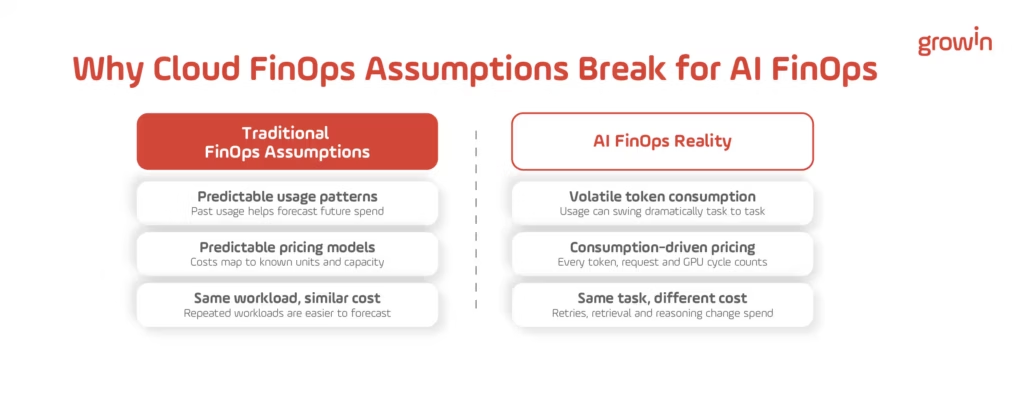
Why AI Costs Break Traditional FinOps Models
Every one of the assumptions below is a reason AI FinOps has to be treated as its own discipline rather than a cloud FinOps checklist with an AI label stapled on top. Get these wrong and every downstream lever in this piece — visibility, chargeback, governance — inherits the same blind spots.
AI spend now outpaces every budget forecast built for it
Standard budgeting assumes that this quarter looks roughly like last quarter, adjusted for growth. AI FinOps has to start from the opposite assumption. According to McKinsey’s research on enterprise AI demand, AI spend increases nearly fourfold as organizations move from isolated pilots to enterprise-wide deployment, and 93% of respondents report exceeding their AI budgets.
That is not a rounding error in a forecast model; it is a sign that the forecast model itself was built for a different kind of spend. Teams that built their general cloud cost optimization playbooks around rightsizing instances and reserved capacity are discovering that none of those levers apply cleanly to a GPU fleet running inference for a model whose usage pattern changes every release cycle.
Token consumption is inherently unpredictable task to task
Like we’ve seen, the FinOps Foundation’s State of FinOps 2026 report puts it plainly: AI management has moved from a niche concern to a near-universal one, with 98% of teams now managing some form of AI spend and “granular monitoring of AI spend — tokens, LLM requests, and GPU utilization” ranked as the single most requested capability practitioners still lack.
The reason it tops every AI FinOps team’s wish list is that token usage does not scale linearly with headcount, feature count, or any other variable finance teams are used to tracking. The same task, run twice, can generate wildly different token volumes depending on retrieval steps, retries, and reasoning depth. AI FinOps exists precisely because this variability breaks the assumptions baked into every prior cost model.
Consumption pricing removes the safety net of seat-based licensing
Seat-based software pricing hid a lot of inefficiency behind a flat number. Consumption-based AI pricing removes that buffer entirely. Gartner’s analysis of rising AI coding costs found that organizations are “underestimating the financial impact of rising token consumption” precisely because vendors have shifted from predictable licensing to usage-based billing without giving buyers equivalent visibility into how that usage is calculated. For a CFO, this means AI FinOps is not optional infrastructure hygiene — it is the only mechanism standing between a reasonable AI budget and a surprise invoice.
The Inference Bill No One Budgeted For
This is the part of AI FinOps that catches most finance teams off guard, because the sticker shock rarely comes from the model itself — it comes from what happens every single time someone uses it, multiplied across every user, every day, indefinitely.
Inference, not training, now drives most AI infrastructure spend
Most executives still picture AI cost as a training problem — the eye-watering price of teaching a model. In production, that is backwards. Once a model is deployed and monitored in production, inference running continuously against real user traffic is what accumulates the bill, and it does so every single day the product is live. This reversal is exactly why AI FinOps treats inference governance as a distinct discipline from the model-selection and training-budget conversations finance teams are more used to having.
GPU utilization sits far below what finance assumes it’s paying for
The uncomfortable number behind most AI FinOps line items is utilization. Cast AI’s 2026 State of Kubernetes Optimization Report, based on data from tens of thousands of clusters, found that GPU utilization across the workloads it analyzed averaged just 5% — meaning the overwhelming majority of expensive, scarce accelerator capacity that companies are paying for by the hour sits idle. As Cast AI’s president put it, cloud vendors have raised H200 prices even as utilization stays this low, which turns a configuration problem into what he calls a business emergency. AI FinOps treats this kind of utilization data as a first-class input, not an engineering afterthought, because it is frequently the single largest recoverable cost in the entire AI budget.
Agentic workflows multiply token volume per completed task
Gartner’s most recent inference-cost forecast adds a second twist for AI FinOps planning: even as the price per token keeps falling, agentic systems consume between 5 and 30 times more tokens per task than a standard chatbot exchange, and they can complete far more tasks than a human ever could in the same window. Gartner’s own framing is blunt — falling token costs will not translate into lower bills if consumption keeps rising faster than price drops. That single dynamic is why AI FinOps has to model demand growth and unit-cost decline as two separate curves, not one.

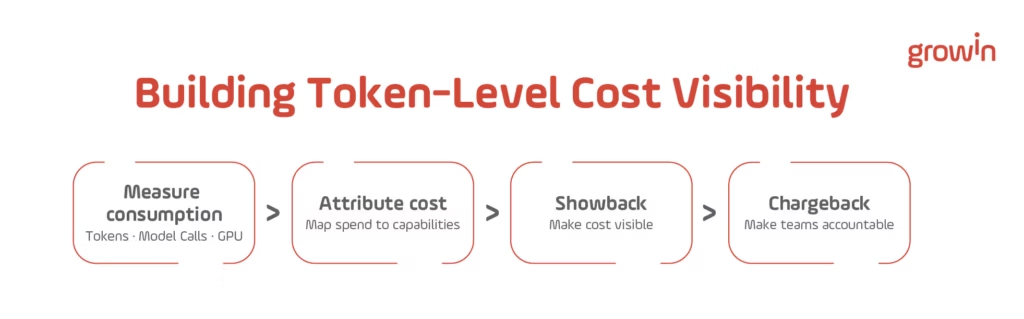
Building Token-Level Cost Visibility
None of the governance work described later in this piece is possible without this step first. AI FinOps, at its core, is a visibility problem before it is ever a policy problem — you cannot govern a number nobody can see.
None of the governance work described later in this piece is possible without this step first. AI FinOps, at its core, is a visibility problem before it is ever a policy problem — you cannot govern a number nobody can see. Most organizations already have visibility at the level of the monthly cloud bill; what AI FinOps requires is the layer underneath it — which team, feature, or agent actually generated a given batch of tokens, and why. Every practice covered in this section exists to build that layer, because an AI FinOps program that only sees the top-line invoice is still flying blind on the decisions that actually drive it.
Showback separates awareness from accountability
Every mature AI FinOps practice starts with showback: making token, inference, and GPU consumption visible to the team that generates it, without yet tying that consumption to a budget consequence. This sounds like a small step, but for most organizations it is the first time anyone outside the platform team has seen what a single feature actually costs to run. It is worth noting that the same observability discipline now shaping how engineering teams instrument distributed systems — the move toward standardized, vendor-neutral telemetry across an application’s full stack — is increasingly being extended to cover model calls and token counts alongside traditional request traces, since the underlying problem (a black box you can’t see inside) is functionally identical.
Chargeback ties consumption to the budget that owns it
Showback tells a team what they’re spending; chargeback makes that spend a real line item against their budget. McKinsey’s research on enterprise AI FinOps found that this shift in accountability is what actually changes behavior — teams that know a token bill will show up against their own P&L build differently than teams that only see it on a shared dashboard.
EY’s own analysis of agentic systems frames this as a distinct discipline it calls Agent FinOps, tracing how a simple 2023-era interaction that cost roughly $0.04 has grown to around $1.20 once tool calls, retries, and reasoning loops are added — a thirty-fold jump that only shows up on an invoice, never on a dashboard nobody is required to look at. That distinction matters enormously for AI FinOps maturity, because showback alone tends to plateau at awareness without ever reaching the cost discipline that a real chargeback model forces.
Feature-level tagging beats team-level tagging for AI attribution
The FinOps Foundation’s guidance for AI FinOps practitioners is specific here: tag at the feature level, not just the team level, so cost can be attributed to the customer-facing capability that generated it rather than to a whole department’s aggregate usage. This is a meaningfully harder tagging problem than traditional cloud FinOps, where a resource tag reliably maps to a team or project. AI FinOps has to trace cost through model calls, retries, and orchestration layers that a simple resource tag was never designed to capture.
Governance Structures That Actually Contain AI Spend
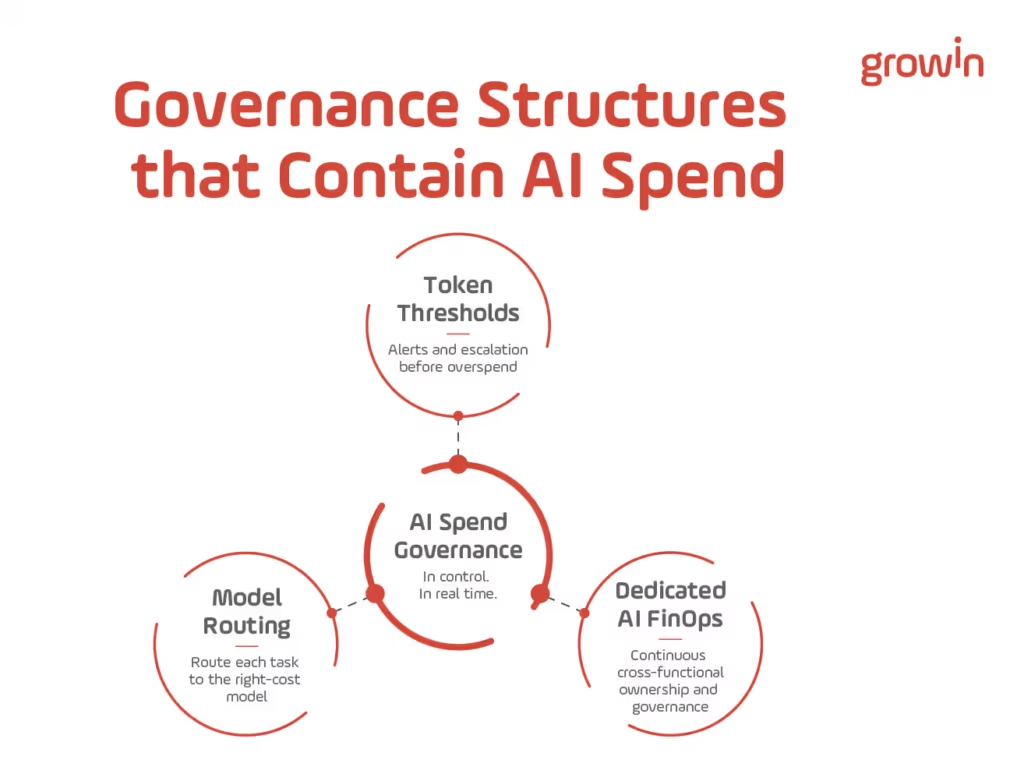
Visibility earns a seat at the table; governance is what keeps AI FinOps from becoming a quarterly post-mortem instead of a real-time control. The three structures below are what turn a dashboard into an actual budget guardrail.
Token thresholds and escalation policies stop silent overspend
Visibility alone does not stop a runaway bill; it only reveals it after the fact. Real AI FinOps governance requires token thresholds, spend alerts, and escalation policies that trigger before a workload blows through its budget, not a monthly report that explains why it already did. Gartner’s recommendation for engineering leaders facing rising AI coding costs is nearly identical in structure: establish clear usage tiers, mandate context-engineering discipline to cut unnecessary token consumption, and embed governance checkpoints directly into the development cycle rather than reviewing spend after the fact.
Model routing sends routine tasks to cheaper models by default
One of the highest-leverage moves inside AI FinOps is deciding, systematically, which tasks actually need a frontier model. Routine, high-frequency requests routed to smaller, cheaper models can match the quality of an expensive model at a fraction of the cost, while genuinely complex reasoning tasks are reserved for the models that justify their price. This kind of intelligent routing is also central to how teams are rethinking AI agent architectures in production, where the choice of model per step in an agent’s workflow has as much bearing on the final bill as the number of steps itself.
A dedicated AI FinOps capability outperforms bolt-on ownership
McKinsey’s research is unambiguous on this point: organizations should build a permanent, cross-functional AI FinOps capability responsible for forecasting demand, monitoring consumption, and evaluating sourcing options, rather than treating AI FinOps as a side project bolted onto an existing cloud FinOps team. The same logic extends to security-minded governance more broadly — the discipline of continuous, automated policy enforcement that keeps a cloud environment from drifting out of its intended configuration is the same discipline that keeps AI spend from drifting out of its intended guardrails, just pointed at a different kind of resource.
What CFOs Should Ask Before Approving the Next AI Budget
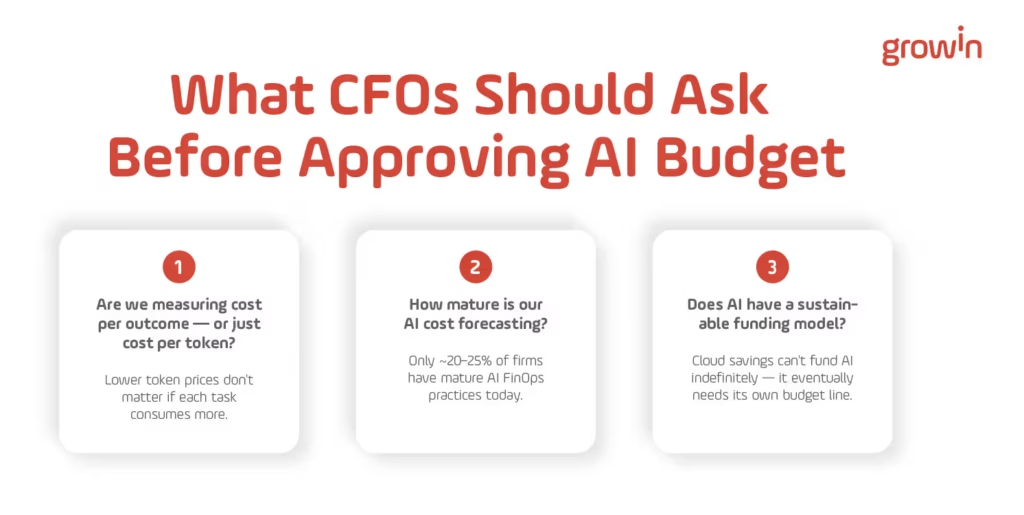
These are the three questions that separate an AI FinOps practice built to last from one that only exists to justify last quarter’s invoice after the fact.
Ask a vendor or an internal team to answer all three, and the quality of the answer tells you more about the maturity of their AI FinOps practice than any dashboard they can show you.
Cost-per-outcome matters more than cost-per-token
The most common mistake in early AI FinOps conversations is optimizing the wrong unit. A falling cost per token feels like progress, but if the number of tokens required to complete a task keeps rising, the bill keeps rising too. McKinsey frames the fix as a shift toward business-outcome metrics — cost per claim processed, cost per resolved ticket, cost per completed workflow — rather than token counts that say nothing about value delivered. CFOs who ask “what does this cost per token” are asking the wrong question; the AI FinOps question is “what does this cost per outcome, and is that outcome worth it.”
Forecasting maturity is now a measurable line item
Organizations with high forecasting maturity save meaningfully more on AI spend than peers who are still budgeting reactively, according to McKinsey’s survey data, yet only a fifth to a quarter of companies surveyed have mature AI FinOps practices in place today. That gap is itself useful information for a CFO deciding where to invest: forecasting discipline is one of the few AI FinOps capabilities with a directly measurable return, which makes it an easier internal case to fund than more abstract governance work. The same discipline that lets engineering teams track delivery metrics like deployment frequency and lead time applies just as well to AI spend — you cannot improve a number nobody is tracking consistently.
Self-funding AI through optimization savings has a ceiling
Many organizations are currently asked to fund new AI initiatives out of savings captured through cloud optimization elsewhere in the budget. That’s a reasonable bridge in year one for an AI FinOps practice still building its internal case. It is not a permanent funding model, because optimization gains inside a mature cloud estate diminish over time — practitioners describe hitting the “big rocks” of waste early and facing steadily smaller, harder-to-capture savings after that.
Flexera’s 2026 State of the Cloud Report found that wasted cloud spend increased for the first time in five years as AI workloads scaled, even as 81% of organizations reported using generative AI in production. AI FinOps needs its own budget line eventually, not a permanent subsidy from a shrinking, and now shrinking-slower, pool of unrelated cloud savings.
Turning AI Cost Governance Into a Competitive Advantage
Organizations that treat AI FinOps as a core operating discipline, not a side conversation between finance and engineering, are the ones scaling AI investment without the budget shocks that are now common across the industry. Gartner’s own research puts a number on what happens without that discipline: more than 40% of agentic AI projects are expected to be canceled by the end of 2027, driven largely by escalating costs and unclear return on investment rather than the technology itself failing to work.
The pattern is consistent across every source cited here — the companies still guessing at next month’s AI invoice are the ones most likely to pull the plug on a promising initiative for financial reasons that better governance would have caught months earlier.
A practical AI FinOps starting point for the next 90 days: establish token and GPU visibility at the feature level before adding any new governance policy on top of it, since policy without visibility just adds friction without adding control. Pair that visibility with one clear chargeback mechanism, even an imperfect one, so that the team generating the spend feels the consequence of it. Then set cost-per-outcome as the metric that actually gets reported upward, not cost-per-token. None of this requires new headcount to start; it requires treating AI spend with the same operating discipline already applied everywhere else in the technology budget.
If your organization is still tracking AI spend on a shared spreadsheet six months after your first production deployment, that is the clearest signal that AI FinOps needs to become a formal capability rather than an occasional exercise. Growin’s intelligent automation and AI advisory services work with engineering and finance teams jointly to build exactly this kind of capability — from cost visibility through to the governance structures that keep AI investment predictable as it scales.