
Frontend architecture has evolved significantly over the past decade. What once involved maintaining a single web application has expanded into ecosystems of applications, shared component libraries, internal tools, and design systems. As organizations scale their frontend capabilities, teams often find themselves managing multiple repositories, each with its own dependencies, tooling configuration, and release cycle.
This fragmentation introduces operational friction. Shared UI components become difficult to maintain across repositories, dependency versions drift between projects, and CI/CD pipelines duplicate work across multiple builds. As frontend platforms grow, the lack of structural coordination across repositories can slow development and increase architectural complexity.
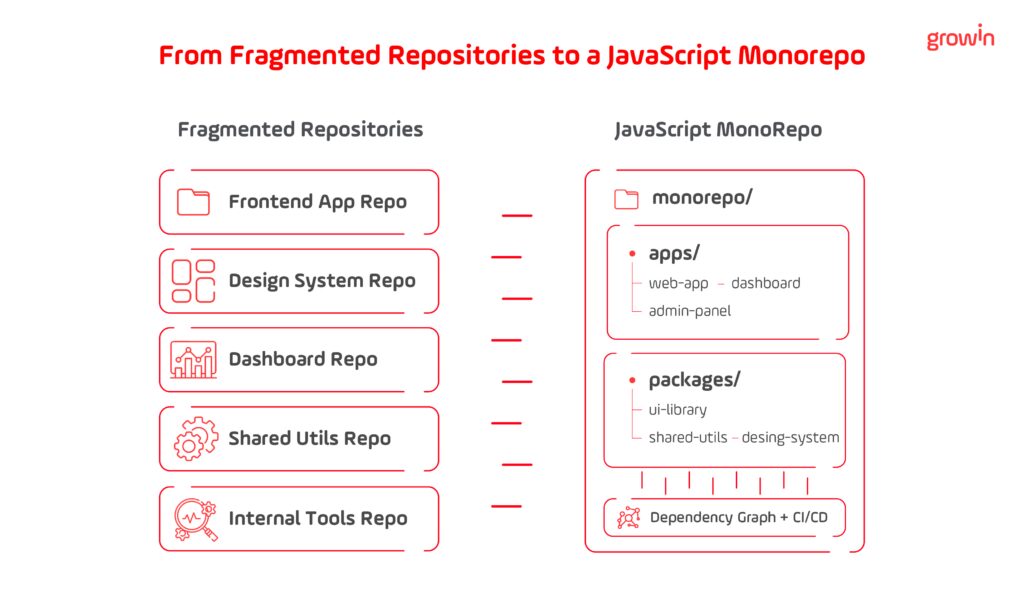
One approach that many organizations are now adopting is the JavaScript monorepo. Instead of managing separate repositories for each frontend application or shared library, a JavaScript monorepo consolidates multiple projects into a single repository structure. This model allows teams to centralize dependency management, coordinate updates across applications, and maintain consistent tooling across the development environment.
The JavaScript monorepo approach has become particularly relevant as frontend systems move toward platform-style architectures. Large organizations frequently operate multiple applications that share design systems, internal APIs, and infrastructure tooling. Managing these interconnected systems within a unified repository allows teams to introduce shared standards and coordinate changes more efficiently across projects.
Modern tooling has made large-scale JavaScript monorepos increasingly practical. Platforms such as Nx and Turborepo provide dependency graph analysis, distributed caching, and incremental builds designed to keep development workflows fast even as repository size grows. These capabilities are becoming central to modern frontend platform engineering practices.
The shift toward structured frontend platforms is also connected to broader industry changes in developer infrastructure and internal developer platforms, where organizations prioritize standardized tooling and shared workflows across teams.
In this article, we explore why the JavaScript monorepo model is gaining traction among frontend teams in 2026. We examine the architectural challenges that lead teams toward monorepos, compare Nx and Turborepo as monorepo orchestration tools, and outline practical best practices for building and operating a JavaScript monorepo at scale.
The Scaling Problem in Modern Frontend Teams
As frontend platforms grow, the limits of traditional repository structures become increasingly visible. Many organizations begin with separate repositories for each application because it feels simple and manageable at the early stages of development. Over time, however, the number of projects increases: customer-facing applications, internal dashboards, design systems, and shared utilities all evolve independently. As these systems expand, maintaining coordination between multiple repositories becomes progressively more difficult.
For large engineering teams, this fragmentation often creates structural inefficiencies. Changes to shared functionality require updates across multiple repositories, dependency versions diverge between projects, and teams spend increasing amounts of time maintaining infrastructure rather than delivering product features. These challenges are one of the primary reasons many organizations begin exploring the JavaScript monorepo model as their frontend ecosystem grows.
Fragmented Repositories and Duplicate Logic
In a multi-repository environment, each frontend application typically evolves in isolation. A design system may exist in one repository, while several applications depend on copies or outdated versions of that code. Shared utilities are often duplicated across repositories because synchronizing changes between projects is slow or risky.
This duplication rarely happens intentionally. It emerges when teams prioritize delivery speed but lack an efficient mechanism for sharing code across repositories. As a result, identical functionality may exist in several places, each maintained independently. Over time, this leads to inconsistent implementations, fragmented UI components, and higher maintenance costs.
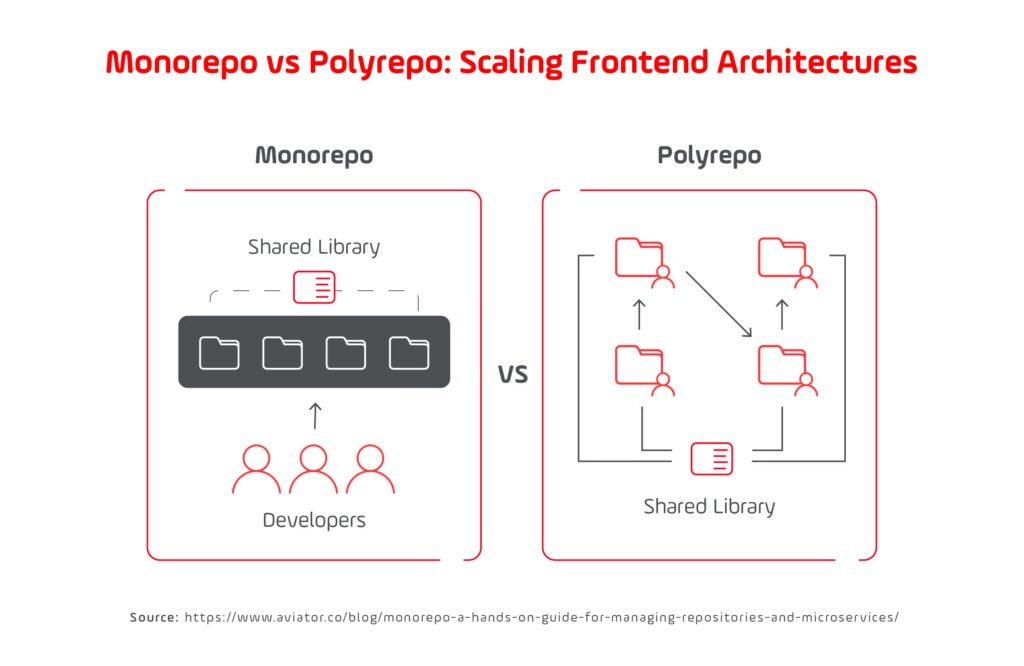
A JavaScript monorepo provides a structural solution by allowing applications and shared libraries to exist within the same repository. Instead of synchronizing code across multiple repositories, teams maintain shared functionality in a single workspace where changes can be introduced and adopted consistently across projects.
Dependency Management Across Frontend Projects
Dependency management becomes increasingly difficult as the number of repositories grows. Each repository may use slightly different versions of frameworks, libraries, or tooling. These differences accumulate over time and eventually create dependency drift, where projects become incompatible with one another or require complex upgrades to align environments.
When teams attempt to standardize dependencies across many repositories, the process often involves coordinated updates across several codebases. This can slow development cycles and increase the risk of integration issues.
A JavaScript monorepo simplifies this challenge by centralizing dependency management within a single workspace. Applications and packages share the same dependency graph, making it easier to maintain consistent library versions and track how changes affect the broader system. Research on large-scale software development has shown that monorepos can significantly improve coordination across teams and reduce integration overhead when multiple projects evolve together.
Build and CI/CD Complexity
Another common challenge in multi-repository environments is the duplication of build and deployment infrastructure. Each repository typically contains its own CI/CD pipeline, testing configuration, and build scripts. As organizations add more projects, maintaining these pipelines becomes increasingly time-consuming.
Even small changes may trigger full builds across multiple repositories, slowing development workflows and increasing infrastructure costs. This problem becomes particularly noticeable when shared libraries are used by several applications, because updates often require rebuilding each project independently.
A JavaScript monorepo enables more efficient build strategies by making relationships between applications and packages visible within the same repository. Modern monorepo tooling can analyze these relationships and execute builds only for projects affected by a change. Platforms such as Turborepo implement task pipelines and caching strategies designed specifically to optimize builds in large repositories.
What a JavaScript Monorepo Actually Solves
As frontend systems grow, teams often struggle to coordinate shared code, dependencies, and infrastructure across multiple repositories. While the polyrepo approach may work for small projects, it becomes increasingly difficult to maintain consistency when many applications evolve simultaneously. A JavaScript monorepo addresses these structural challenges by consolidating applications, shared libraries, and development tooling into a single repository workspace.
Rather than managing separate repositories that evolve independently, teams working in a JavaScript monorepo operate within a unified environment where code sharing, dependency alignment, and coordinated changes become significantly easier. This model does not simply centralize code; it introduces architectural visibility into how different parts of the system interact.
Centralized Workspace Architecture
One of the most immediate advantages of a JavaScript monorepo is the ability to organize multiple applications and shared packages inside a single workspace. Rather than distributing projects across many repositories, teams structure their systems around directories such as applications, libraries, and development tooling.
This structure improves architectural clarity. Engineers can easily understand how applications relate to shared components, and updates to common libraries can be applied across projects without publishing packages between repositories. Centralized workspaces also make it easier to maintain consistent project conventions, testing configurations, and development environments.
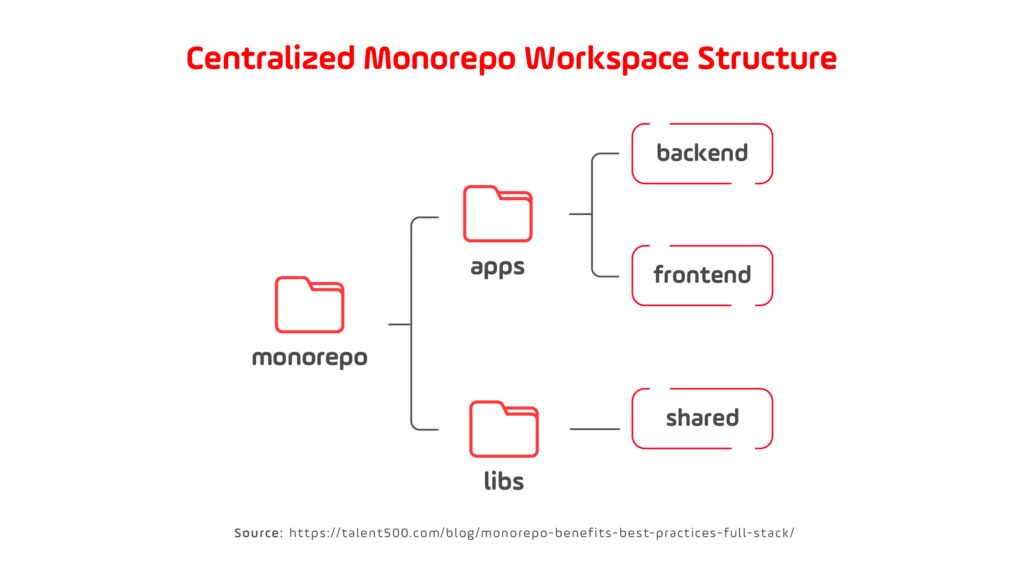
The monorepo.tools documentation explains that monorepos allow teams to manage multiple projects within a single repository while sharing dependencies and development infrastructure.
Shared Libraries and Dependency Graphs
Another major benefit of a JavaScript monorepo is the ability to maintain shared libraries efficiently. Design systems, UI components, and internal utilities can exist alongside the applications that use them. Instead of copying code between repositories or managing several package versions, teams maintain a single source of truth.
Within a JavaScript monorepo, development tooling can also visualize relationships between packages through dependency graphs. These graphs help engineers understand how changes in one library may affect other parts of the system, making it easier to manage large codebases.
Modern monorepo tooling relies heavily on dependency graph analysis to coordinate builds and detect which projects are affected by code changes.
Atomic Changes Across Frontend Applications
In traditional multi-repository environments, updating shared functionality often requires synchronized changes across several repositories. For example, updating a design system component may require separate updates to each application that depends on that component. Coordinating these changes introduces risk and slows development.
A JavaScript monorepo allows teams to perform atomic changes across applications and shared libraries within a single commit. Developers can modify shared code and immediately update the applications that depend on it without coordinating releases across multiple repositories. This approach reduces integration issues and simplifies platform evolution as frontend systems grow.
Engineering discussions around large-scale repositories frequently highlight atomic cross-project changes as a key advantage of monorepo architectures.
Nx and Turborepo: Two Approaches to JavaScript Monorepos
As JavaScript monorepos grow, managing builds, dependencies, and development workflows becomes increasingly complex. While the monorepo structure itself solves many architectural challenges, large repositories still require tooling that can coordinate tasks across multiple applications and shared packages. This is where platforms such as Nx and Turborepo play an important role.
Both tools are designed to help teams manage large JavaScript monorepos efficiently. They provide mechanisms for dependency graph analysis, incremental builds, and optimized task execution. Instead of rebuilding every project when code changes, these tools analyze relationships between packages and run only the tasks that are actually affected.
How Nx Manages Large JavaScript Monorepos
Nx is a monorepo development platform designed to help teams maintain scalable repository architectures. It introduces a structured workspace model where applications and libraries are organized in a predictable layout. Nx also generates a dependency graph that helps developers understand how packages interact across the repository.
One of the key advantages of Nx is its affected build system. When code changes, Nx determines which projects depend on that code and executes tasks only for those affected projects. This approach can significantly reduce build times in large JavaScript monorepos where rebuilding the entire repository would otherwise be expensive.
Nx also includes features for code generation, project scaffolding, and automated architectural enforcement. These capabilities help teams maintain consistent project structures as their repositories grow. The Nx documentation explains how dependency graphs and affected builds allow teams to optimize development workflows within large workspaces.
How Turborepo Optimizes Monorepo Pipelines
Turborepo takes a slightly different approach by focusing on high-performance build pipelines and caching strategies. Developed originally by Vercel, Turborepo is designed to make task execution across JavaScript monorepos extremely fast through incremental computation and distributed caching.
When developers run build or test commands, Turborepo determines which tasks are affected by the change and retrieves results from a cache whenever possible. This caching system can dramatically reduce execution times for tasks that have already been completed in previous builds.
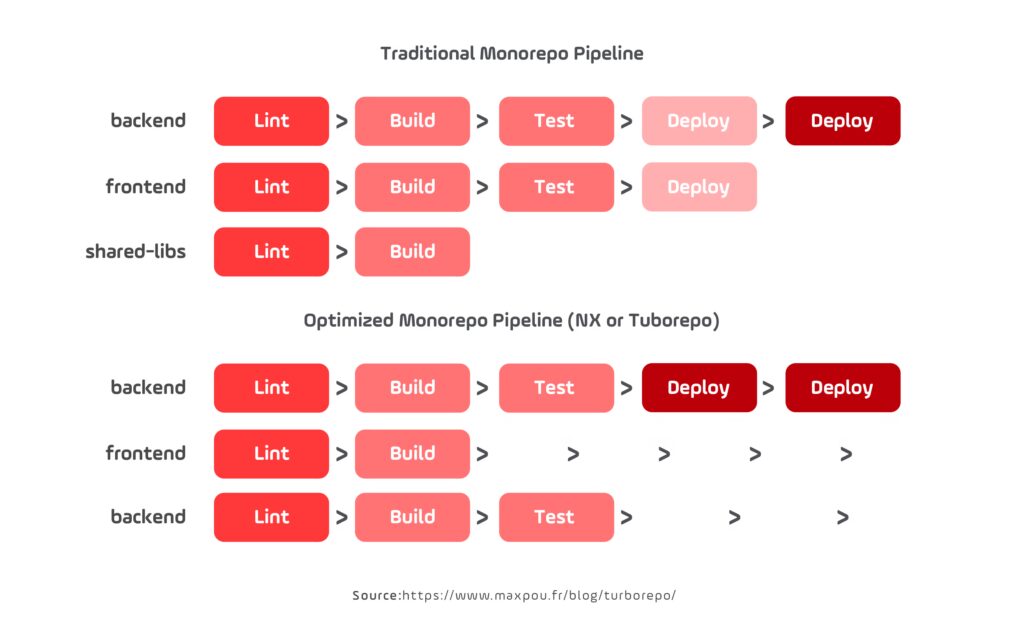
Turborepo organizes tasks through pipelines that define relationships between build steps. These pipelines ensure that commands run in the correct order across applications and shared packages. According to the Turborepo documentation, task pipelines and caching allow large repositories to scale without significantly increasing build times.
Choosing the Right Tool for Your JavaScript Monorepo
Both Nx and Turborepo aim to solve similar problems, but they emphasize different aspects of monorepo development. Nx focuses more heavily on workspace structure, dependency management, and architectural tooling. Turborepo prioritizes performance optimization and fast build pipelines.
For many frontend teams, the choice depends on the size of the repository and the complexity of the platform they are building. Teams managing large enterprise JavaScript monorepos with many applications may benefit from Nx’s architectural tooling, while teams focused primarily on performance and build speed often prefer Turborepo’s lightweight pipeline model.
Regardless of the tool chosen, the goal remains the same: to maintain fast development workflows while managing the complexity of a growing JavaScript monorepo.
CI/CD Pipelines in a JavaScript Monorepo
Once teams adopt a JavaScript monorepo, CI/CD pipelines become a central component of the development workflow. Instead of running independent pipelines for each repository, a monorepo pipeline must coordinate builds, tests, and deployments across multiple applications and shared libraries. This shift changes how engineering teams think about automation.
Dependency-aware build execution is widely recommended for large repositories because CI systems increasingly rely on workflows that trigger tasks only when specific parts of the codebase change.
In a traditional multi-repository setup, pipelines often operate in isolation. Each project triggers its own builds, even if changes do not affect that particular service or application. In contrast, a JavaScript monorepo pipeline relies on dependency awareness and task orchestration to ensure that only the necessary tasks run when code changes. This approach significantly reduces build times and infrastructure costs.
Modern CI/CD strategies for monorepos therefore focus on three core capabilities: dependency-aware builds, incremental execution, and coordinated release processes.
Dependency-Aware Build Execution
One of the main advantages of a JavaScript monorepo pipeline is the ability to run builds only for projects affected by a change. Instead of rebuilding the entire repository every time a developer pushes code, modern monorepo tooling analyzes the dependency graph to determine which applications or libraries need to be rebuilt.
For example, if a developer updates a shared UI component, the pipeline can automatically identify which frontend applications depend on that component and trigger builds only for those projects. This approach dramatically reduces unnecessary computation and allows pipelines to scale as the repository grows.
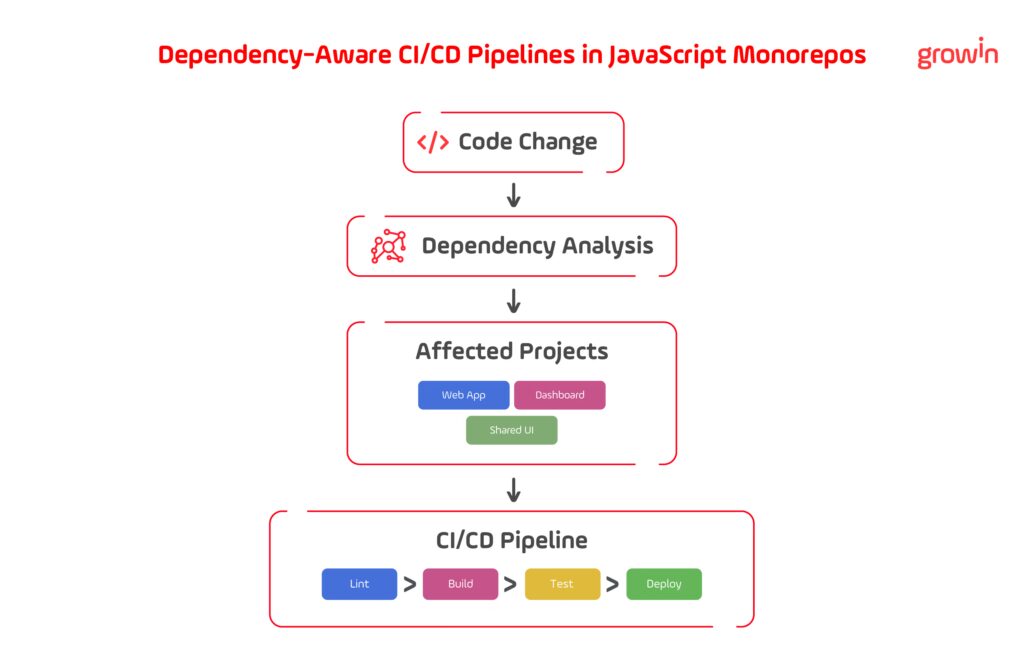
Dependency-aware build execution is now a widely recommended practice for large repositories because it prevents CI pipelines from becoming a bottleneck as engineering teams expand.
Incremental Builds and Task Caching
Another key technique used in JavaScript monorepo pipelines is incremental execution. Instead of rerunning tasks that have already completed successfully, build systems can reuse cached results when the underlying code has not changed.
This concept is especially powerful when combined with distributed caching. If a developer runs a build locally and another developer triggers the same task in CI, the system can retrieve the cached result rather than executing the build again. This reduces redundant work across the development team.
Incremental build strategies have become increasingly common in large-scale software systems because they allow CI/CD pipelines to remain fast even as codebases grow in size and complexity.
Coordinated Releases Across Applications
Another challenge addressed by JavaScript monorepos is release coordination. In a multi-repository environment, deploying updates that span multiple projects often requires coordinating releases across several independent pipelines. This process can introduce delays and increase the risk of version mismatches.
Within a JavaScript monorepo, releases can be coordinated more easily because the applications and shared libraries exist within the same repository. Teams can update a shared package and deploy dependent applications in a controlled sequence within a single pipeline.
For frontend platforms that rely heavily on shared design systems or component libraries, coordinated releases can significantly reduce integration issues and simplify deployment strategies across multiple applications.
Architecture Best Practices for a JavaScript Monorepo
Adopting a JavaScript monorepo can simplify code sharing and repository management, but the benefits only appear when the repository is structured intentionally. Without clear boundaries and governance, monorepos can become difficult to maintain as the number of applications and contributors grows. Engineering teams therefore need architectural practices that ensure the repository remains scalable, understandable, and efficient.
A well-designed JavaScript monorepo typically emphasizes clear workspace boundaries, consistent shared libraries, and predictable build performance. These practices help teams maintain development velocity while avoiding the complexity that large repositories can introduce.
Define Clear Workspace Boundaries
One of the most important principles in a JavaScript monorepo is establishing clear boundaries between applications and libraries. Applications should represent deployable systems such as web apps, dashboards, or services, while libraries should contain reusable components, utilities, or domain logic.
Separating these responsibilities helps prevent code duplication and makes it easier to reason about dependencies across the repository. Teams often enforce these boundaries using folder structures, linting rules, or tooling constraints that prevent applications from importing code directly from other applications.
Maintaining clear workspace boundaries also improves long-term maintainability. When dependencies are structured deliberately, developers can quickly identify which projects rely on shared packages and which parts of the system are affected by changes.
Engineering teams managing large monorepos frequently emphasize strict module boundaries and dependency awareness as a way to maintain architecture discipline as repositories grow.
Maintain Well-Governed Shared Libraries
Shared libraries are one of the biggest advantages of a JavaScript monorepo. Instead of duplicating code across multiple repositories, teams can centralize common functionality in reusable packages such as UI components, design systems, API clients, and utility modules.
However, shared libraries also introduce the risk of uncontrolled dependencies. If every application depends on a large number of shared packages, the repository can become tightly coupled and difficult to evolve.
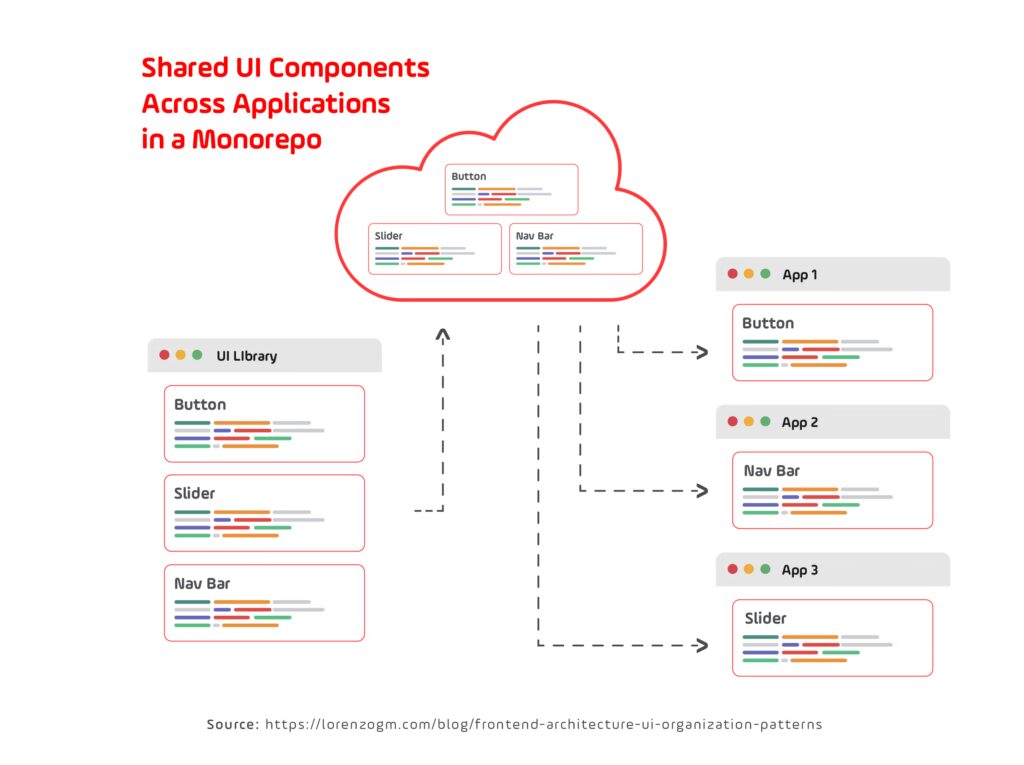
To avoid this, teams often categorize libraries based on responsibility. For example, some libraries may contain low-level utilities, while others provide higher-level application features. This layered approach helps prevent circular dependencies and encourages developers to reuse the correct abstractions.
Clear ownership of shared libraries is also important. Assigning maintainers for critical packages ensures that updates, refactoring, and dependency changes are reviewed carefully before affecting multiple applications.
Protect Build Performance as the Repository Grows
As a JavaScript monorepo grows, maintaining fast builds becomes a critical engineering challenge. Without optimization strategies, CI/CD pipelines may begin rebuilding large portions of the repository even when only a small part of the codebase changes.
To maintain performance, teams rely on several techniques such as dependency-aware builds, caching strategies, and incremental task execution. These techniques allow pipelines to determine which projects are affected by a change and execute tasks only where necessary.
Another useful practice is splitting the repository into logical project groups that can be built independently when possible. Combined with caching and task orchestration tools, this approach keeps development workflows responsive even as the monorepo expands.
Large organizations often adopt these strategies to ensure that a growing JavaScript monorepo remains efficient without sacrificing the advantages of centralized code management.
Common Failure Modes of JavaScript Monorepos
While a JavaScript monorepo can significantly improve collaboration and code sharing across frontend teams, the approach is not without risks. Without clear governance and architectural discipline, monorepos can become difficult to scale and maintain. Many organizations that struggle with monorepos do so not because the model is flawed, but because the repository lacks clear ownership, dependency boundaries, or performance safeguards.
Understanding these failure modes helps engineering teams adopt a JavaScript monorepo in a way that preserves its advantages while avoiding structural complexity. The most common problems typically emerge around dependency management, repository growth, and unclear project ownership.
Uncontrolled Dependency Graphs
One of the most common challenges in a JavaScript monorepo is the emergence of uncontrolled dependencies between applications and libraries. If teams are allowed to import code freely across the repository, the dependency graph can quickly become tangled and difficult to reason about.
This problem often leads to tightly coupled projects, where changes in one library unexpectedly affect multiple applications. Over time, this increases the risk of regressions and makes it harder for teams to evolve parts of the system independently.
To prevent this issue, teams usually enforce architectural constraints that restrict how projects depend on one another. For example, applications may be allowed to depend only on libraries, while libraries follow a layered structure that prevents circular dependencies.
Modern monorepo tooling frequently includes dependency visualization features that help teams detect problematic relationships between projects before they grow into larger architectural issues.
Oversized Repositories and Build Bottlenecks
Another failure mode occurs when a JavaScript monorepo grows without maintaining efficient build strategies. As the repository expands to include more applications, libraries, and contributors, CI pipelines may begin rebuilding large portions of the codebase even when changes affect only a small part of the system.
Without incremental builds and dependency-aware execution, this can lead to extremely long build times and slower development cycles. Engineers may begin to experience delays when running tests, generating builds, or deploying applications.
To mitigate this problem, teams typically adopt caching strategies, dependency-aware pipelines, and task orchestration tools that ensure only affected projects are rebuilt. These practices help maintain fast development workflows even as the repository grows in size and complexity.
Engineering teams managing large-scale repositories frequently emphasize build caching and task orchestration as essential practices for maintaining CI performance in large monorepos.
Lack of Ownership Across Projects
A third common challenge appears when repository ownership is unclear. Because a JavaScript monorepo consolidates many projects into a single repository, it can sometimes blur the boundaries of responsibility between teams.
If no clear maintainers are assigned to applications or shared libraries, changes may be introduced without proper review or architectural oversight. Over time, this can lead to inconsistent code quality, conflicting design patterns, and fragile dependencies between projects.
Many organizations address this challenge by establishing explicit ownership rules within the repository. Teams may be responsible for specific applications, shared libraries, or platform tooling. Code ownership files, repository governance guidelines, and structured review processes help ensure that changes are reviewed by the engineers most familiar with the affected projects.
Clear ownership practices ensure that a JavaScript monorepo remains manageable even as the number of teams and applications grows.
What JavaScript Monorepos Change for Frontend Architecture in 2026
The rise of the JavaScript monorepo reflects a broader shift in how frontend platforms are built and maintained. Modern frontend systems rarely consist of a single application. Instead, organizations operate multiple products, dashboards, internal tools, and shared component systems that evolve together. Managing these systems across isolated repositories often introduces coordination overhead, duplicated work, and fragmented tooling.
A JavaScript monorepo changes this dynamic by turning the repository into a shared development platform rather than a collection of independent projects. Applications, libraries, and tooling coexist in a single environment where dependencies, build processes, and workflows can be coordinated. As frontend architectures continue to expand, this approach allows teams to maintain consistency while scaling development across multiple products.
From Application Repositories to Platform Architecture
Historically, frontend teams treated each application as an independent repository. While this model worked for smaller teams, it often led to duplicated components, inconsistent build pipelines, and fragmented developer tooling as organizations scaled.
A JavaScript monorepo encourages teams to treat the repository as a platform layer that supports multiple applications. Shared design systems, utility libraries, and infrastructure tooling become part of a unified workspace rather than being distributed across separate repositories.
This architectural shift makes it easier to maintain consistent development environments, shared code standards, and coordinated release workflows across projects. As a result, engineering teams can focus more on building features and less on maintaining infrastructure across disconnected repositories.
Developer Productivity at Scale
Another important impact of a JavaScript monorepo is its effect on developer productivity. When codebases are distributed across many repositories, developers often spend time navigating different tooling setups, dependency versions, and build configurations.
By contrast, a JavaScript monorepo creates a consistent environment where engineers can work across applications without constantly switching contexts. Shared dependencies, centralized tooling, and unified build systems reduce the friction associated with contributing to multiple projects.
This consistency becomes particularly valuable for organizations operating multiple frontend products or internal platforms. Engineers can reuse existing libraries, extend shared components, and contribute improvements that benefit several applications simultaneously.
Large engineering teams increasingly adopt monorepo architectures because they simplify collaboration across projects while maintaining a coherent development environment.
The Future of Scalable Frontend Systems
As frontend ecosystems continue to evolve, the complexity of managing multiple applications and shared libraries will only increase. JavaScript monorepos provide a structural foundation that helps teams manage this complexity without sacrificing development speed or architectural clarity.
Tools such as Nx and Turborepo demonstrate how modern build systems can orchestrate large repositories efficiently through dependency graphs, caching strategies, and incremental task execution. Combined with clear architectural practices and governance, these tools enable organizations to scale their frontend platforms without losing maintainability.
For teams managing several frontend applications or building shared design systems, adopting a JavaScript monorepo is less about following a trend and more about establishing a sustainable engineering model for the future.