
React Server Components represent one of the most consequential shifts in React’s architecture since the introduction of Hooks. By allowing components to execute on the server by default, React fundamentally changes how rendering, data access, and performance optimization are approached in modern web applications.
In 2026, React Server Components are no longer a conceptual experiment confined to framework demos. They are actively used in production systems built with Next.js, influencing how teams structure component trees, fetch data, and reason about client-side complexity. At the same time, adoption remains uneven. Many teams enable Server Components expecting automatic performance improvements, only to encounter architectural constraints, unexpected coupling, or limited gains in real-world conditions.
The core challenge is that React Server Components are not an optimization layer. They are an architectural boundary. They shift responsibility from the browser to the server, change the cost model of rendering, and require teams to think explicitly about execution environments.
This article focuses on React Server Components in production contexts. It explains what they actually are beyond the headline, why they exist, and how they alter application design decisions. The goal is not to promote adoption by default, but to help teams understand when React Server Components create leverage and when they introduce unnecessary complexity.
What React Server Components Actually Are
What They Do and Why They Exist
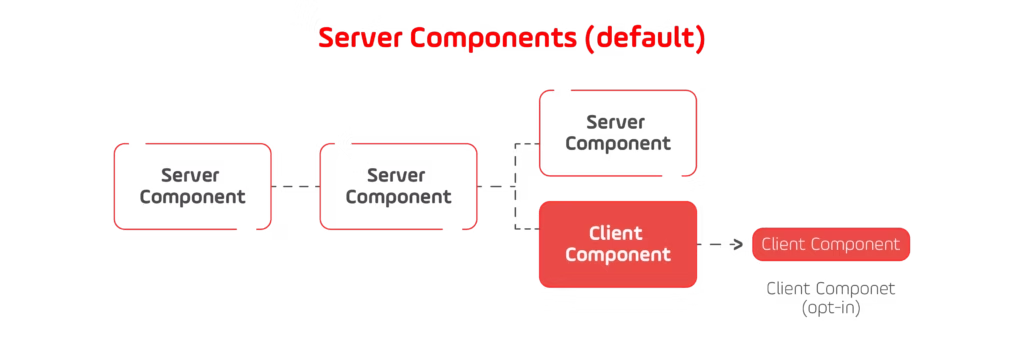
React Server Components allow parts of a React application to run exclusively on the server and stream their rendered output to the client without sending the component’s JavaScript code to the browser. Unlike traditional server-side rendering, these components never hydrate and never execute in the client runtime.
The motivation behind this model is structural rather than incremental. As React applications grew, client-side bundles absorbed responsibilities that were never meant to live in the browser: data orchestration, access control, formatting logic, and complex aggregation. This led to larger bundles, duplicated data-fetching layers, and higher cognitive load for frontend teams.
Server Components address this by redefining the default execution environment. Components are assumed to be server-first unless explicitly marked otherwise. This makes server access a baseline capability rather than an exception, allowing frontend code to interact directly with databases, internal services, and backend-only APIs during render.
This approach aligns with long-standing performance principles discussed in our post React Performance Optimization: Best Techniques for Faster, Smoother Apps in 2025, particularly the idea that reducing client-side work often delivers larger gains than micro-optimizing JavaScript execution.
How React Server Components Work in Practice
React Server Components introduce a strict separation between server and client execution. Components that rely on browser APIs, stateful interactivity, or lifecycle hooks must be explicitly marked with “use client”. Everything else can remain server-only.
During rendering, the server evaluates Server Components, resolves data dependencies, and streams a serialized representation of the UI to the client. Client Components are referenced but not executed until needed. This enables progressive rendering without transferring unnecessary JavaScript.
In practice, this model enforces several constraints:
- Server Components cannot use state or effects
- Client Components cannot import Server Components
- Data fetching happens synchronously during render
- The component tree becomes an execution graph
These constraints are intentional. They force teams to make architectural decisions explicit and reduce accidental coupling between data, rendering, and interactivity. However, they also require a mental model that differs significantly from traditional React development.
The official React documentation outlines this execution model and its constraints in detail, but production usage often reveals edge cases around caching, streaming behavior, and error handling that are not obvious during initial adoption.
Benefits of React Server Components in Production
Why Server-First Rendering Changes Performance Characteristics
React Server Components change performance not by making React faster, but by changing where work happens. In traditional client-heavy React applications, the browser is responsible for fetching data, executing rendering logic, and coordinating component dependencies. This often leads to sequential data access, duplicated logic, and unnecessary JavaScript execution on the client.
By moving non-interactive components to the server, React Server Components allow data fetching and rendering to occur in an environment optimized for parallelism and low-latency access to backend resources. The browser receives a serialized representation of the UI rather than the code required to produce it, reducing both payload size and execution cost.
This shift aligns with long-standing frontend performance guidance, where minimizing client-side JavaScript is consistently one of the highest-impact optimizations. It also builds on ideas previously explored in Growin’s React Performance Optimization: Best Techniques for Faster, Smoother Apps in 2025, where reducing main-thread pressure is central to sustained performance gains.
Smaller Bundles and Reduced Client Complexity
One of the most immediate benefits teams observe when adopting React Server Components is a reduction in JavaScript bundle size. Because Server Components never ship to the browser, entire sections of rendering and data-access logic are removed from the client bundle by design.
In production systems, this leads to:
- Faster initial loads, especially on constrained devices
- Lower parse and execution times
- Reduced memory usage in the browser
More importantly, it simplifies client-side code. Client Components can focus exclusively on interactivity and local state, rather than acting as orchestration layers for data and rendering logic. This separation reduces cognitive load for frontend teams and makes component responsibilities clearer over time.
These improvements are particularly visible in applications that previously relied heavily on client-side data fetching and state management libraries, a pattern common in JAMstack-style architectures discussed in React and JAMstack: Building Modern Web Applications in 2025.
Parallel Data Fetching and Elimination of Waterfalls
Because Server Components execute on the server, data dependencies can be resolved in parallel during render rather than sequentially in the browser. Parent and child components can fetch their required data independently, without blocking on client-side lifecycle timing.
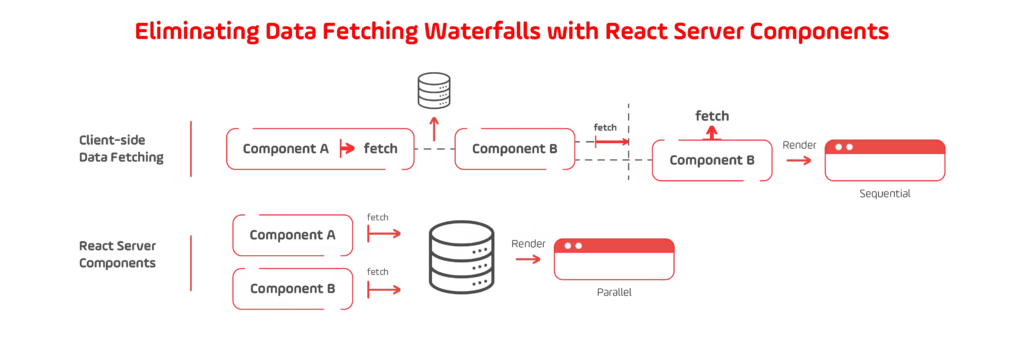
This eliminates a common class of performance issues where one request must complete before another can even be initiated. In production environments with multiple backend dependencies, the difference between parallel and serialized fetching often translates directly into user-perceived latency.
This benefit is not automatic. It emerges only when components are structured to take advantage of server execution. When done correctly, it allows teams to express data requirements declaratively at the component level while still achieving efficient request behavior.
Better Security and Data Boundary Enforcement
React Server Components also strengthen security boundaries by default. Since Server Components never execute in the browser, sensitive logic and credentials remain confined to the server environment. This reduces the risk of accidental data exposure and simplifies compliance with internal security policies.
From an architectural perspective, this encourages a clearer separation between public-facing UI and private system logic. It also reduces the need for defensive API layers whose sole purpose is to protect backend resources from client misuse.
This server-centric model aligns with broader industry guidance around frontend security and controlled data access, such as those outlined in API Security Playbook: 10 Best Practices Developers Should Follow.
Pitfalls and Failure Modes of React Server Components
When Server Components Recreate the Same Old Problems
React Server Components do not automatically eliminate performance issues. They change the execution model, but they do not remove poor component design, implicit dependencies, or unexamined data access patterns. In production systems, teams often discover that simply moving logic to the server does not guarantee parallelism or efficiency.
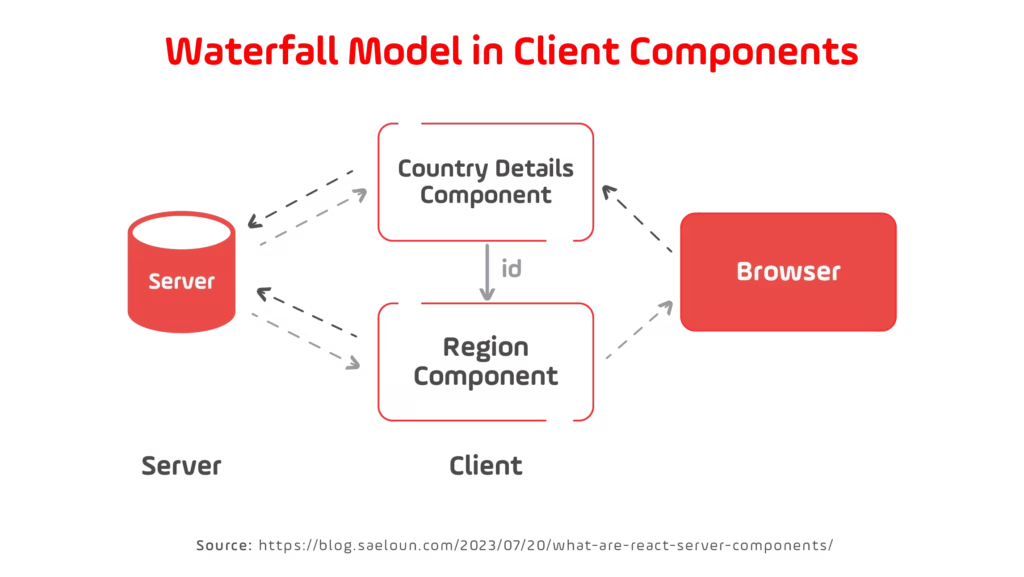
The most common failure mode is recreating client-side waterfalls on the server. This happens when Server Components depend on each other’s data in a serialized way, forcing requests to resolve sequentially even though they are no longer running in the browser. The result is a system that looks modern on paper but behaves like a traditional, tightly coupled rendering pipeline.
At this stage, many teams are surprised. The tooling is correct, the framework supports Server Components, and yet latency remains stubbornly high.
Server-Side Waterfalls Are Still Waterfalls
Server Components can fetch data during render, but they still obey dependency order. If a parent component waits for data before rendering a child, and that child triggers its own data fetch, the requests will still execute sequentially. The only difference is that the delay now happens on the server instead of in the browser.
This is where architectural intent matters more than syntax. Parallelism only emerges when components are structured so their data requirements are independent. If data dependencies form a chain, the server will faithfully execute that chain step by step.
Misplaced Client Boundaries and Accidental Client Promotion
Another frequent pitfall is overusing “use client” as an escape hatch. When teams encounter friction with Server Components, the temptation is to promote components to the client to regain access to hooks, state, or familiar patterns.
In production systems, this often leads to:
- bloated client bundles
- fragmented data-fetching logic
- blurred responsibility between server and client layers
Worse, Client Components can only import other Client Components. A single misplaced “use client” directive can silently pull large portions of the component tree back into the browser, undoing many of the gains discussed in the previous section.
This failure mode is subtle because it rarely breaks functionality. Instead, it erodes performance and maintainability gradually, making it harder to diagnose once the application grows.
Caching Assumptions That Don’t Hold in Production
Server Components often rely on implicit caching behavior provided by frameworks or runtime environments. In controlled examples, this works well. In production, caching behavior is influenced by deployment topology, data volatility, and request patterns.
Teams frequently assume that server-side rendering implies automatic reuse of work. In reality, cache boundaries must be designed deliberately. Without a clear caching strategy, Server Components can trigger repeated backend calls under load, shifting bottlenecks rather than removing them.
This is particularly problematic in multi-tenant systems or applications with highly dynamic data, where naive caching can lead to stale UI or excessive invalidation.
Why These Pitfalls Matter More at Scale
These failure modes tend to surface only after applications grow. Small projects rarely hit the complexity threshold where component dependency graphs and caching behavior become dominant factors. At scale, however, the difference between parallel and serialized execution becomes visible to users.
React Server Components amplify architectural decisions. Well-structured systems become faster and simpler. Poorly structured systems become harder to reason about, because the execution path is split across environments.
Understanding these and other pitfalls is essential before applying best practices, which is where the next section will focus.
Best Practices for Using React Server Components in Production
Design Around Data Dependencies First
Successful use of React Server Components starts with understanding data dependencies, not components. In production systems, performance outcomes are determined less by where components live and more by how their data requirements relate to each other.
When designing with React Server Components, teams should begin by identifying which data can be fetched independently and which dependencies are inherently sequential. Server Components are most effective when data requirements can be resolved in parallel during render. If component data is tightly chained, simply moving execution to the server will not improve latency.
This means architectural design often needs to precede UI composition. React Server Components reward teams that treat the component tree as a data dependency graph rather than a purely visual hierarchy.
Keep Client Components Explicit and Minimal
One of the most important best practices with React Server Components is maintaining discipline around client boundaries. Client Components should exist only where interactivity, local state, or browser APIs are strictly required.
Every “use client” directive introduces cost:
- additional JavaScript shipped to the browser
- loss of direct server data access
- stricter import constraints across the component tree
In production, this means Client Components should be:
- shallow in the tree
- clearly documented
- reviewed with the same rigor as API boundaries
While React Server Components and Client Components can coexist in the same component tree, their relationship is intentionally asymmetric. Server Components may render Client Components, but the reverse is not allowed.
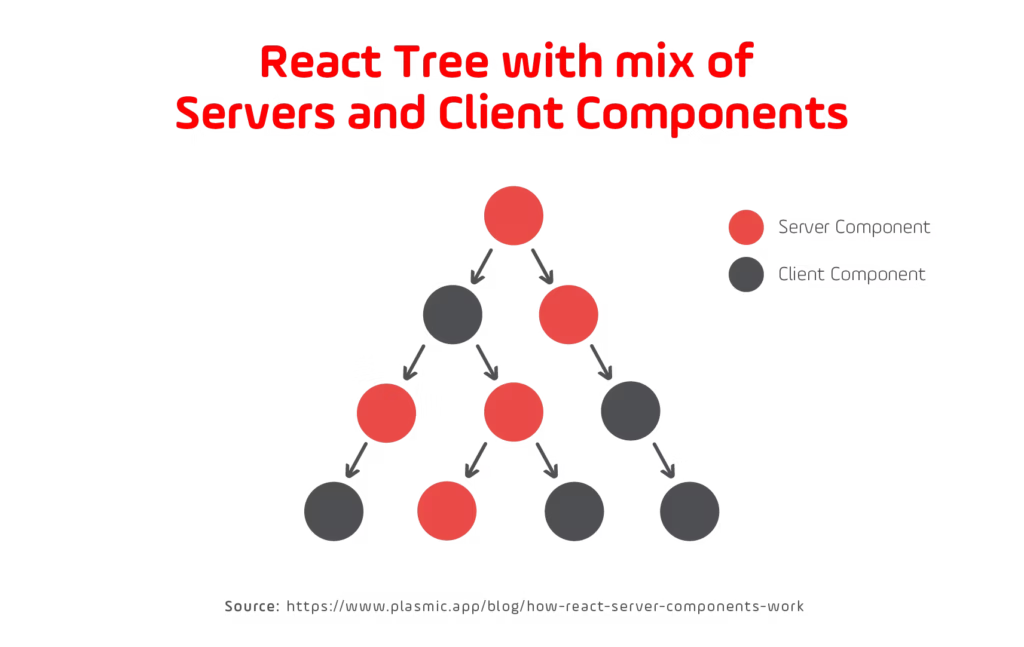
Client Components cannot import or depend on Server Components, which means any client boundary effectively becomes a cutoff point in the tree. This constraint is fundamental to the model: it prevents server-only logic from leaking into the browser and forces teams to treat client interactivity as an explicit opt-in rather than a default.
React Server Components work best when Client Components are treated as exceptions, not defaults. This reinforces the server-first model and preserves the structural benefits introduced earlier.
Treat Streaming as an Optimization, Not a Requirement
Streaming is often discussed as a headline feature of React Server Components, but in production it should be treated as an optimization layer rather than a baseline assumption. Not every interface benefits from incremental rendering, and misuse can increase complexity without improving user experience.
Teams should introduce streaming only when:
- meaningful UI can be shown before all data resolves
- partial content reduces perceived latency
- error handling is well understood
React Server Components enable streaming, but they do not mandate it. Production systems benefit most when streaming is applied selectively and measured carefully.
Guidance on streaming behavior and tradeoffs is outlined in the official React documentation, which remains the most authoritative reference for understanding supported patterns and constraints.
Be Deliberate About Caching and Reuse
Caching behavior is one of the least understood aspects of React Server Components in production. Server execution does not automatically imply shared or persistent computation. Cache scope depends on framework configuration, request context, and deployment topology.
Best practices include:
- explicitly defining cache boundaries
- understanding when data is request-scoped vs reusable
- avoiding assumptions about implicit memoization
In large systems, uncontrolled server-side fetching can simply move bottlenecks from the browser to backend services. React Server Components amplify both good and bad caching strategies, making intentional design critical.
Instrument and Observe the Server Render Path
Because React Server Components execute on the server, observability must extend beyond traditional frontend tooling. Teams should instrument:
- server render latency
- backend request fan-out
- cache hit and miss behavior
- streaming completion timing
Without this visibility, it becomes difficult to distinguish between framework behavior and architectural inefficiencies. Production confidence with React Server Components comes from measuring the full render lifecycle, not just client-side metrics.
When React Server Components Are the Wrong Choice
Highly Interactive, Client-Heavy Interfaces
React Server Components are a poor fit for interfaces dominated by continuous client-side interaction. Applications such as complex dashboards, design tools, or real-time collaborative environments often rely heavily on local state, frequent re-renders, and direct browser APIs.
In these scenarios, most of the component tree inevitably becomes client-bound. The repeated use of “use client”collapses the server-first advantage while preserving the coordination overhead, resulting in an architecture that is harder to reason about than a traditional client-driven React application.
This tradeoff becomes particularly visible in large-scale frontend systems where performance issues stem from interaction complexity rather than data-fetching patterns, as explored in JavaScript Performance at Scale in 2026: What Actually Breaks in Real-World Applications.
Offline-First or Edge-Constrained Applications
React Server Components assume reliable server access at render time. Applications designed around offline-first principles, local persistence, or constrained edge environments often violate this assumption.
In these cases, pushing rendering and data orchestration closer to the client provides greater resilience. Server-first rendering can introduce brittle failure modes when connectivity is intermittent or latency is unpredictable.
This tension mirrors broader frontend performance considerations documented in the Chrome UX Report, which highlights how network reliability and device constraints shape real-user experience outcomes.
Teams Without Strong Backend Ownership
Adopting React Server Components shifts responsibility toward the server. Frontend teams interact directly with backend data sources, caching behavior, and request lifecycles during render.
Organizations without clear backend ownership or shared operational responsibility often struggle with this model. Without alignment, frontend teams may unknowingly introduce backend load, cache contention, or security risks.
This organizational dependency is similar to challenges seen when introducing platform-level abstractions without corresponding ownership, discussed in Platform Engineering in 2026: 5 Shifts Driving the Rise of Internal Developer Platforms.
Low-Complexity Applications With Stable Performance
Not every application benefits from architectural sophistication. For smaller systems with predictable traffic, modest data needs, and stable performance, the cost of introducing React Server Components may outweigh the gains.
If bundle sizes are already controlled and performance targets are consistently met, introducing a new execution model adds cognitive and operational overhead without removing a real constraint.
In these situations, effort is often better spent on cost efficiency and operational simplicity, themes explored in Cloud Cost Optimization: What Works in Multi-Cloud Environments for 2026.
Architectural Mismatch Is More Costly Than Technical Debt
The most important reason not to adopt React Server Components is architectural mismatch. The model rewards disciplined data boundaries, explicit execution environments, and server-aware frontend design.
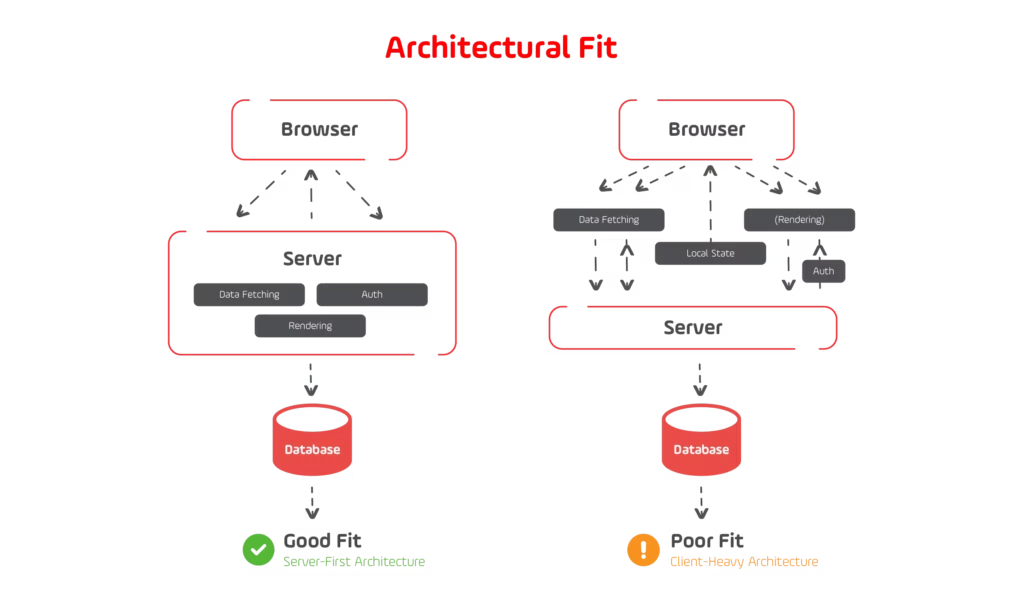
Teams optimized for rapid iteration and loose coupling may find these constraints limiting. In such contexts, React Server Components can slow delivery and complicate onboarding rather than improving outcomes.
Choosing not to adopt is not a failure. It is often a sign of architectural maturity.
Choosing React Server Components Is an Architectural Decision, Not a Feature Toggle
React Server Components represent a meaningful shift in how frontend systems can be designed and operated. They offer real advantages in performance, security, and maintainability, but only when applied within the right architectural context.
Across production environments, the difference between success and disappointment rarely comes down to syntax or framework support. It comes down to understanding data dependencies, execution boundaries, team ownership, and long-term operational impact. React Server Components amplify these decisions rather than hiding them.
For organizations navigating this shift, the goal should not be adoption for its own sake, but alignment. Alignment between frontend and backend teams. Alignment between interaction patterns and execution models. Alignment between architectural ambition and organizational readiness.
At Growin, we support teams making these kinds of decisions every day — whether that means designing scalable architectures, assembling dedicated software teams with the right backend and frontend balance, or extending existing teams through nearshore development and staff augmentation to accelerate delivery without sacrificing quality. Our work focuses on helping organizations adopt modern approaches pragmatically, ensuring that architectural choices translate into measurable outcomes, not just technical novelty.
The right question is no longer whether React Server Components are the future.
It’s whether they are the right fit for your system, your teams, and your goals.