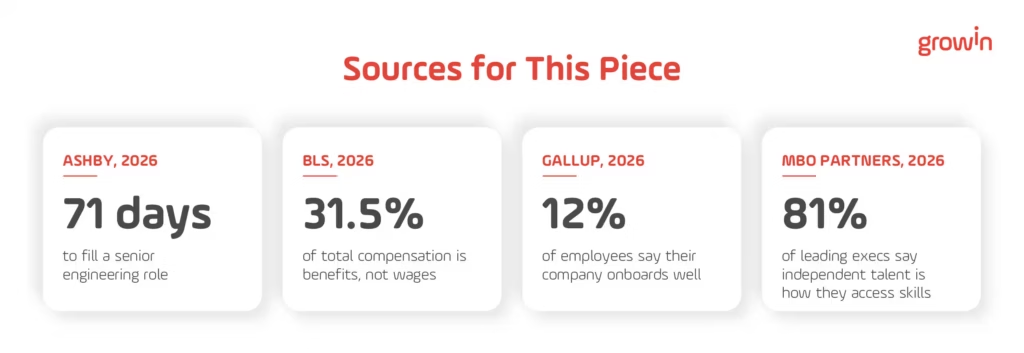
Talent augmentation takes the blame for slow ramp-up and disconnected hires. Gallup finds only 12% of companies actually onboard anyone well, augmented staff included.
Companies bring in talent augmentation to move faster and reach skills they don’t have in-house. The complaints tend to follow within a quarter: the new person never quite feels like part of the team, ramp-up drags longer than expected, and whatever they learned walks out the door when the contract ends. Those complaints get filed under “talent augmentation doesn’t work,” as if the staffing model itself were the variable that failed.
Companies bring in talent augmentation to move faster and reach skills they don’t have in-house. The complaints tend to follow within a quarter: the new person never quite feels like part of the team, ramp-up drags longer than expected, and whatever they learned walks out the door when the contract ends. Those complaints get filed under “talent augmentation doesn’t work,” as if the staffing model itself were the variable that failed.
The data points somewhere else. Gallup has been measuring onboarding quality across the US workforce for years, and the number barely moves: only 12% of employees say their company does a good job onboarding anyone, new hire or not. That’s not a talent-augmentation statistic. It’s a baseline, and it applies before anyone decides whether the next person added to a team is a full-time hire or an augmented one.
Six findings below walk through what’s actually slow about adding capacity, what a full-time hire actually costs once the comparison is done honestly, and why the organizations already getting real value out of talent augmentation aren’t the ones who onboard the least. The pattern holds whether the decision-maker is weighing a single contractor or a whole augmented team, because the onboarding process doesn’t change shape based on headcount, and neither does the math behind why it matters.
Hiring your own engineer is already slow, augmented or not
The implicit comparison behind most “talent augmentation is faster” pitches is a company’s own hiring pipeline. That pipeline is slower than most people assume, which changes what talent augmentation is actually competing against. The real baseline isn’t a fast internal search versus a slower external one, it’s a slow internal search that a company has usually already tried before it goes looking for an alternative.
Senior engineering roles take 71 days to fill, 37% longer than junior ones
Ashby’s Recruiting Operations Benchmarks, drawn from more than 54 million applications and 93,000 jobs between January 2021 and March 2026, puts the median time to first fill at 52 days for junior roles and 71 days for senior ones it’s 37% longer. SHRM’s separate 2026 Recruiting Executives Benchmarking report, covering more than 4,600 organizations, found a median time-to-fill of 39 calendar days across nonexecutive roles economy-wide. Engineering hiring already runs well past that broader baseline before talent augmentation enters the conversation at all, which is worth sitting with before calling any alternative staffing model “the slow option”.
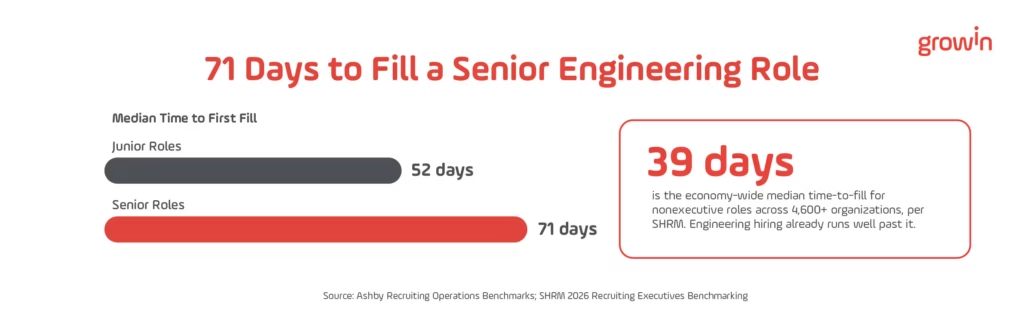
The gap isn’t just a longer queue. Ashby’s own data attributes it to senior and technical roles pulling more applications per opening and running through more interview stages, with deeper technical evaluation stretching each stage further than a typical junior search needs. A company isn’t just waiting longer for a senior hire in that case. It’s running a heavier process end to end, and that weight doesn’t disappear just because the person eventually filling the seat is a full-time employee rather than someone brought in through talent augmentation.
Technical hiring loops already run longer than other functions
The same Ashby data found technical roles take roughly 15 days longer to fill than business roles overall, with the screen-to-final-interview stretch alone running about 18 days for technical candidates against 14 for business ones. A company that needs an engineer isn’t choosing between “fast” and “talent augmentation.” It’s choosing between a multi-month internal search it has likely already run once and whatever route gets a qualified person in front of the work sooner the second time.
None of this makes a direct hire the wrong call. It means the speed argument for talent augmentation isn’t being made against a fast alternative, it’s being made against a pipeline that, by the industry’s own benchmarking data, already takes weeks longer than most hiring managers plan for.
The fully loaded cost of a hire rarely gets compared honestly
The number that gets compared against a talent augmentation hourly rate is almost always base salary. Base salary is not what a full-time hire costs, and the gap between the two is where most “talent augmentation is expensive” conclusions quietly go wrong. Fixing that comparison doesn’t require exotic data, it just requires using numbers that are already public.
Finance and HR already have a name for this: fully loaded cost. The US Small Business Administration has long cited 1.25 to 1.4 times base salary as a rough planning range once payroll taxes, benefits, equipment, and overhead are added in, well before any company-specific numbers enter the picture. A talent augmentation rate shows up as one line in one budget. A full-time hire’s true cost is split across payroll, benefits administration, IT provisioning, and often a different department’s budget line entirely, which is exactly why it’s so easy for a procurement conversation to compare the two unevenly without anyone intending to.
Benefits alone add 31.5% on top of wages
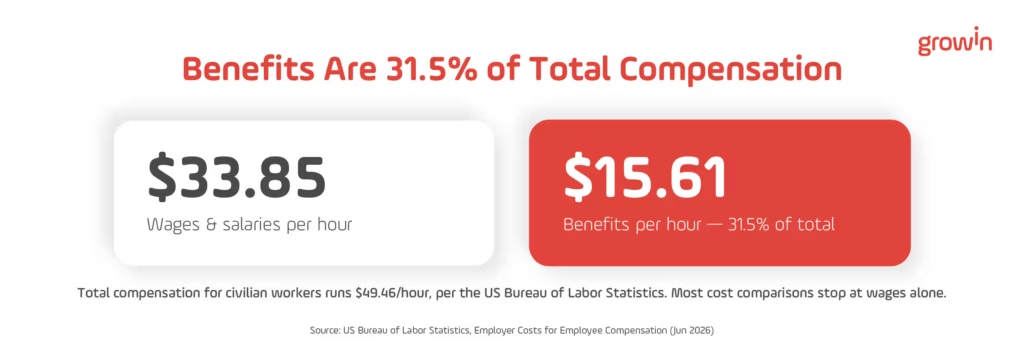
The US Bureau of Labor Statistics’ Employer Costs for Employee Compensation release, for civilian workers as of June 2026, puts total compensation at $49.46 an hour against $33.85 in wages and salaries alone. Benefits make up the remaining $15.61 — 31.5% of the total, on top of the number most cost comparisons stop at.
That 31.5% doesn’t include recruiting time or the weeks a role sits open
Benefits load is the part of the true cost that’s easiest to look up. It still leaves out recruiting spend, hiring-manager hours, and the 39 to 71 days a role typically sits open before anyone starts, per the SHRM and Ashby figures above. None of that shows up in a base-salary-versus-hourly-rate comparison, and all of it is real cost a company is already paying before talent augmentation enters the picture as an alternative.
Put the two numbers next to each other honestly and the comparison looks different than the one most procurement conversations actually have. A talent augmentation rate is a single, visible line item, quoted up front and easy to put in a spreadsheet. A full-time hire’s true cost is scattered across payroll, benefits administration, recruiting budget, and months of partial productivity, which makes it easy to undercount every one of those pieces except the one on the offer letter, and easy to treat talent augmentation as the expensive option by comparison.
Only 12% of companies actually onboard new people well
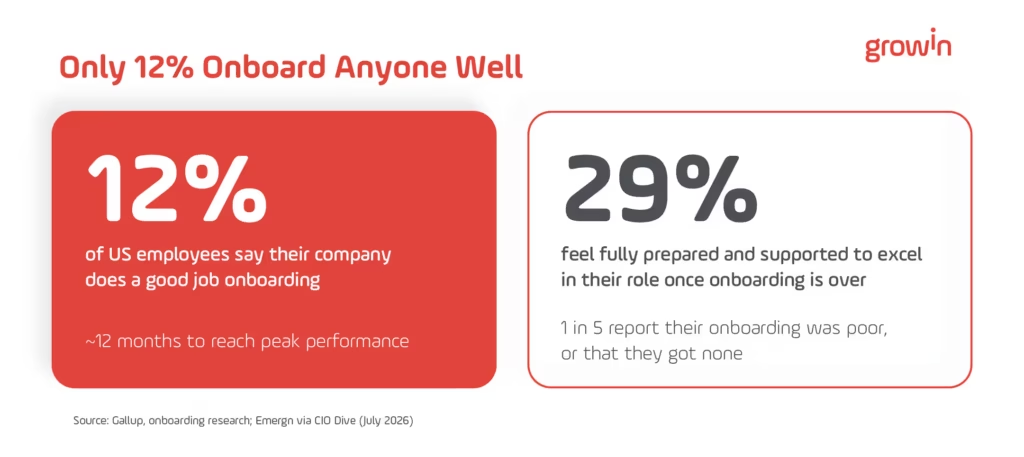
If talent augmentation and full-time hires both land inside the same broken onboarding process, the process is the variable worth examining, not the employment model. This is the finding the rest of this piece keeps returning to, because it reframes almost every complaint made about augmented staffing specifically.
12% say their company does a good job onboarding, and just 29% feel fully prepared afterward
Gallup’s onboarding research found only 12% of US employees say their company does a good job onboarding new people. One in five report their most recent onboarding was poor, or that they received none at all, and only 29% of new hires say they feel fully prepared and supported to excel in their role once onboarding is over. None of that question wording singles out contractors, interims, or talent augmentation specifically, it’s asked of the entire US workforce, which is exactly why it’s a fair baseline to measure augmented engagements against.
Even with no issues at all, it takes about 12 months to reach peak performance
The same research puts the typical timeline to peak performance at around 12 months for a new employee under ordinary conditions. That’s the baseline every new person is measured against, whichever payroll they’re on. A talent augmentation engagement that gets blamed for “never really getting up to speed” is frequently just running into this same industry-wide number on a shorter clock, not failing some standard unique to contract work.
Twelve months is also long enough that most companies never notice it as a distinct line item for a full-time hire, it gets absorbed into a multi-year tenure without anyone naming it. Talent augmentation doesn’t get that same accounting grace, which is part of why the same ramp-up curve reads as a bigger problem when it shows up on a shorter engagement, even though the underlying curve is identical either way.
A fixed-term engagement has far less runway to absorb a bad process
Twelve months to peak performance is a tolerable cost for a role a company expects to keep filled for years. It’s a much bigger bite out of a talent augmentation engagement built to run a fraction of that length, which is exactly where the reputational damage actually originates. The math isn’t complicated once it’s laid out, which makes it worth laying out plainly rather than leaving as a vague sense that “contractors take a while to get going.”
Talent augmentation engagements commonly run 3 to 12 months, not years
Industry practice across talent augmentation providers typically structures engagements in the 3-to-12-month range, renewed or extended as the need continues, rather than as an open-ended hire. Measured against Gallup’s 12-month peak-performance baseline, a poorly onboarded contractor can spend most or all of a short engagement still climbing the same curve a poorly onboarded full-time hire has years to work through.
The complaint lands on the staffing model, not the onboarding gap that caused it
A contractor who never gets proper context, a clear point of contact, or early access to the systems they need will look unproductive on exactly the same timeline a full-time hire would, except there’s no multi-year runway left to average it out. The slow ramp gets remembered as “talent augmentation doesn’t integrate,” when the Gallup numbers above say the same onboarding gap was already sitting there waiting for anyone new, employee or not.
That distinction matters for how a company diagnoses a disappointing engagement afterward. Blaming the staffing model closes the question before the actual cause — an onboarding process that was never built for anyone’s first 90 days, augmented or permanent — gets examined at all.

Good onboarding changes outcomes regardless of who’s doing the work
The reverse of the finding above is the more useful one for a company actually deciding what to do next: fixing onboarding doesn’t just blunt a risk, it produces measurably different results, and those results aren’t specific to full-time headcount. The same lever applies whether the next person added to a team is a permanent hire or brought on through talent augmentation.
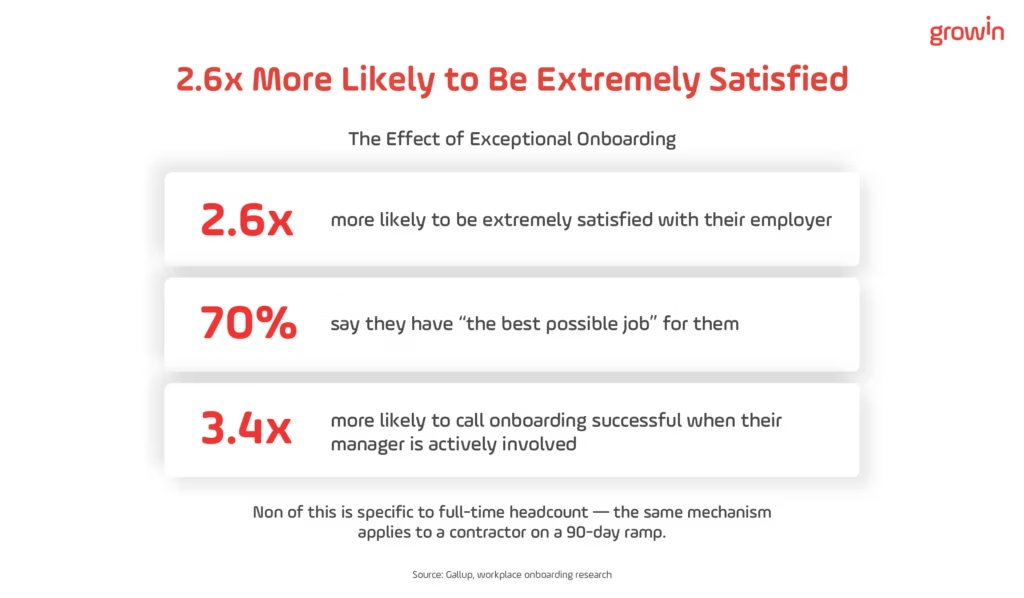
Employees with strong onboarding are 2.6 times more likely to be extremely satisfied
Gallup’s same research found that employees who described their onboarding as exceptional were 2.6 times as likely to be extremely satisfied with their employer, and 70% of them said they had “the best possible job” for them. Active manager involvement specifically made employees 3.4 times as likely to call their onboarding successful.
None of that effect is specific to full-time headcount
Nothing in Gallup’s methodology isolates these gains to permanent employees. The mechanism being measured — clear context, early access, a defined point of contact, active involvement from whoever’s leading the work — applies identically to a contractor on a 90-day ramp. A company that extends the same onboarding discipline to talent augmentation is applying a lever with a documented 2.6x effect, not taking a chance on an unproven one.
That reframes what a “good” talent augmentation partner is actually responsible for. It isn’t just sourcing a qualified person faster than an internal search would. It’s making sure that person lands inside the 12% of onboarding processes that work, instead of the 88% that don’t, and treating that as part of the service being delivered, not an afterthought left to whichever manager happens to be free that week.
Leading organizations already treat talent augmentation as a skills strategy, not a cost patch
Put the onboarding findings together with how sophisticated buyers are actually using talent augmentation today, and a clearer picture of where this is heading emerges. The companies getting the most out of talent augmentation aren’t the ones using it to avoid hiring. They’re the ones using it to reach skills a slower internal pipeline wasn’t going to produce anyway.
81% of executives at leading-edge organizations say it’s how they access high-value skills
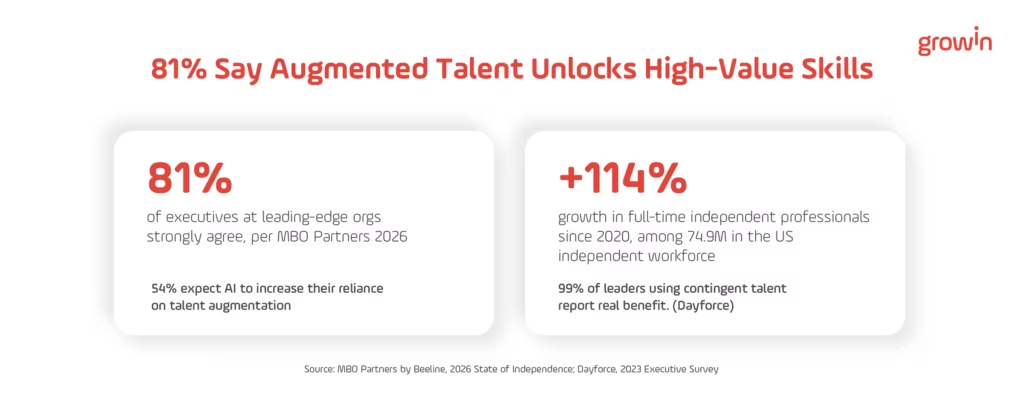
MBO Partners by Beeline’s 2026 State of Independence report, which surveyed 84 corporate executives with in-depth interviews for its enterprise-focused findings, found 81% of executives at leading-edge organizations strongly agree that independent and augmented talent provides access to high-value skills their own workforce doesn’t have. The same report found the US independent workforce reached 74.9 million people in 2026, with full-time independent professionals growing 114% since 2020, a market getting bigger, not more marginal, at exactly the moment this report measured it.
Companies already using contingent talent report concrete gains, not just flexibility
A 2023 global executive survey of 2,000 leaders, covered by Dayforce, found 99% of leaders whose organizations use contingent workers reported benefiting from it, with increased productivity (54%), greater workforce flexibility (51%), and increased organizational agility (50%) as the top-cited gains. More recent data backs the same direction: 54% of enterprises in the MBO Partners report expect AI to increase their reliance on talent augmentation over the next two years, not decrease it. Taken together, the buyers with the most experience using augmented talent are moving toward it, not away from it, which is a hard pattern to square with the idea that the staffing model itself is the problem.
What this means for teams considering talent augmentation
None of the six findings above argue that talent augmentation has no risk. They argue the risk most often blamed on it — slow ramp-up, disconnected contractors, work that never quite lands — is the same risk sitting inside every company’s hiring pipeline already, measured by Gallup at a 12% success rate regardless of who’s being onboarded.
That reframes the actual decision. The question isn’t whether to trust an outside model of staffing. It’s whether the onboarding process a new person walks into is one of the 12% that’s actually good, because that number predicts outcomes far better than the line on a contract. A company that wouldn’t tolerate a 71-day search ending in a new hire who gets a laptop and no context shouldn’t tolerate the same thing happening to an augmented engineer either, the fix is identical in both cases, and it has nothing to do with which payroll the person lands on.
Organizations already getting real value from talent augmentation, per MBO Partners’ own data, are the ones treating it as a skills-access strategy worth building a real onboarding process around, not a faster way to skip one. That’s the distinction worth carrying into the next headcount conversation: the providers worth evaluating are the ones who treat getting someone properly onboarded as part of the service, not as the client’s problem to solve once the contract starts. Talk to Growin about what a properly onboarded talent augmentation engagement actually looks like before the next headcount decision gets made.