
The conversation around AI in software development has shifted. For the past two years, the dominant story was about copilots — tools that suggest the next line of code, autocomplete a function, or flag a bug while a developer types. That story was real, and the productivity gains were measurable. But it was also limited. A copilot only acts when prompted. It holds no state, executes no plan, and stops the moment you stop typing.
AI agents in software development work differently. They receive a goal, decompose it into tasks, call the tools they need, run those tasks in parallel, and return a result — with minimal hand-holding in between. That shift from assistant to autonomous collaborator is what makes 2026 a genuinely different moment for engineering leaders. According to Anthropic’s 2026 Agentic Coding Trends Report, developers now use AI for roughly 60% of their work, yet can only fully delegate 0–20% of tasks to agents without oversight. The capability is real. The operational readiness, for most organisations, is not yet there.
This article is for CTOs who need to understand the landscape before committing to a scaling strategy — what has actually changed, where the adoption data sits, where teams are deploying agents successfully, and where the real friction lives.
How AI Agents in Software Development Differ from Copilots
The distinction between a copilot and an AI agent in software development is not cosmetic. It reflects a fundamental change in how work gets initiated, executed, and verified.
Prompts versus goals
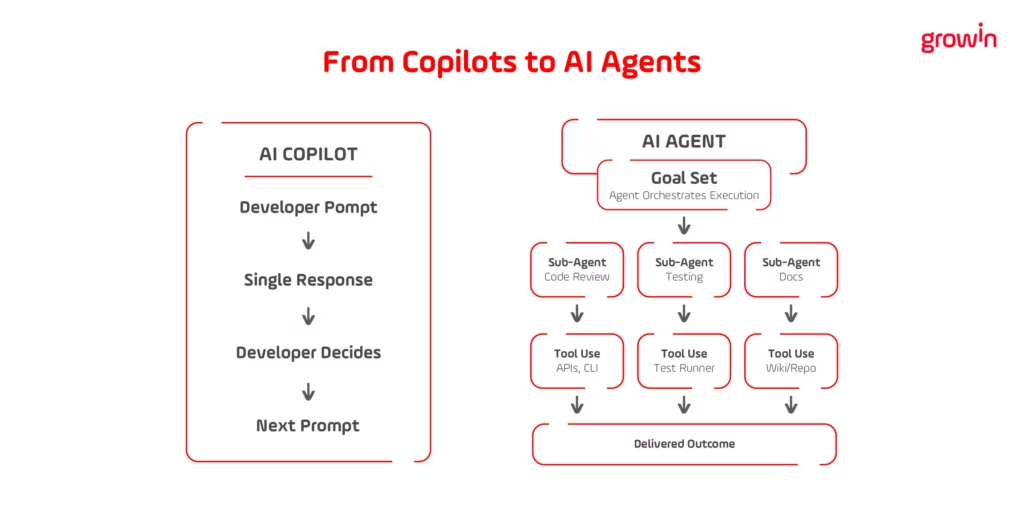
A copilot responds to a prompt and waits for the next one. The human remains the driver of every step — writing the instruction, reviewing the output, deciding what comes next. An AI agent in software development operates on goals. You hand it a task with an intended outcome — “review the open PRs, run the test suite, flag regressions, and update the changelog” — and the agent decides how to get there. It plans, it sequences, it recovers from errors without asking for help at every turn.
This is not a subtle difference. It changes the role of the engineer from executor to supervisor, and it changes the unit of work from a prompt-response exchange to a defined mission with observable milestones.
Tool use and parallel execution
To act on goals rather than prompts, AI agents in software development need two capabilities that copilots lack: tool use and parallel execution. Tool use means the agent can call APIs, read and write to repositories, execute CLI commands, run test suites, and interact with external systems — not just generate text. Parallel execution means the work can be decomposed into streams handled simultaneously by specialised sub-agents, each with its own context and scope.
The market has formalised this architecture quickly. The category now includes coding assistants, AI-native IDEs, terminal-based agents, and full agentic platforms — and the line between them is blurring fast as frontier model providers move into direct competition with application-layer vendors.
New vocabulary, new infrastructure
For engineering leaders, the vocabulary shift is also an infrastructure signal. Terms like orchestrator agent, sub-agent, agent harness, and MCP (Model Context Protocol) are no longer niche jargon — they describe systems your teams will be building on, integrating with, or procuring within the next 12 months. Understanding what they mean before the vendor conversations start is a practical advantage.
MCP in particular deserves attention. It is the protocol that allows AI agents in software development to connect to external tools, data sources, and services in a standardised way — think of it as the USB-C of agentic infrastructure. Without it, every agent integration is a custom build. With it, agents can switch tools, share context, and operate across systems without being rebuilt from scratch each time. CTOs evaluating agent platforms should treat MCP support as a baseline requirement, not a differentiator.
The Numbers CTOs Should Have on Their Radar
The adoption curve for AI agents in software development is steep — and the gap between experimentation and production is the defining tension of 2026.
Market scale and velocity
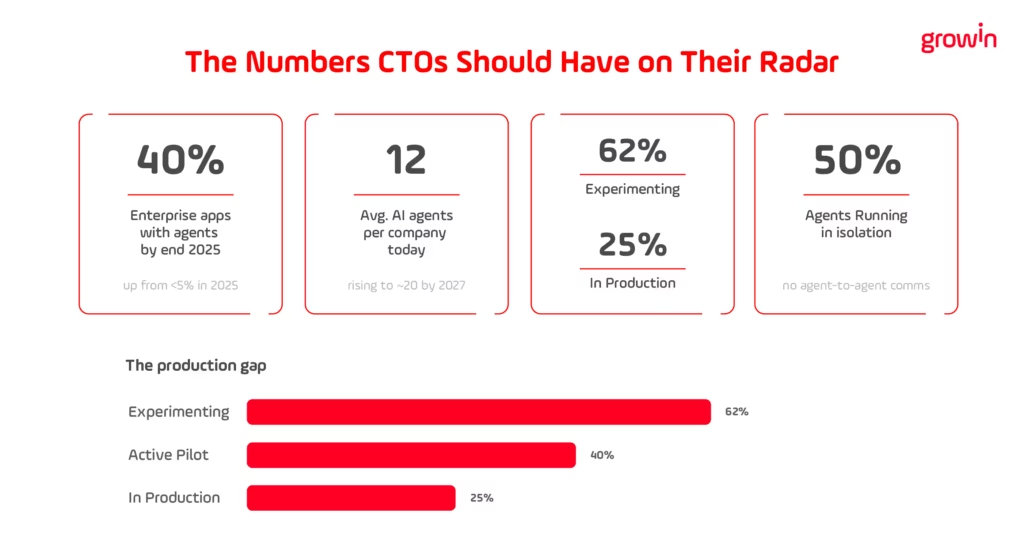
Gartner projects that 40% of enterprise applications will include task-specific AI agents by end of 2026, up from less than 5% in 2025. Spending on agentic AI is expected to reach $201.9 billion in 2026 — a 141% increase over 2025. By 2027, spending on agents will surpass spending on traditional chatbots and assistants combined. These are not incremental numbers. They reflect a structural reorientation of enterprise technology investment.
What this means in practice is that budget pressure to adopt is arriving faster than operational readiness to govern. CTOs who wait for internal demand to build before developing an agent strategy will find themselves making architecture decisions under time pressure — the worst possible condition for getting them right. The organisations pulling ahead are not necessarily the ones spending the most. They are the ones that started thinking about governance, tooling, and team capability 12 to 18 months before the mandate arrived.
Where companies actually stand
The average company already runs 12 AI agents today, a number expected to reach 20 by 2027. But half of those agents operate in complete isolation — no agent-to-agent communication, no shared context, no handoffs. That isolation significantly limits what multi-agent systems can accomplish and is one of the clearest indicators that most organisations are in early deployment mode, not mature operation.
The production gap
McKinsey reports that while 62% of organisations are experimenting with AI agents in software development, fewer than 25% have scaled them to production. That 37-point gap is not a capability problem — the tools exist and work. It is an operational and organisational one. Understanding why pilots stall is more useful to a CTO right now than any feature comparison of agent platforms.
Where Engineering Teams Are Actually Deploying Agents
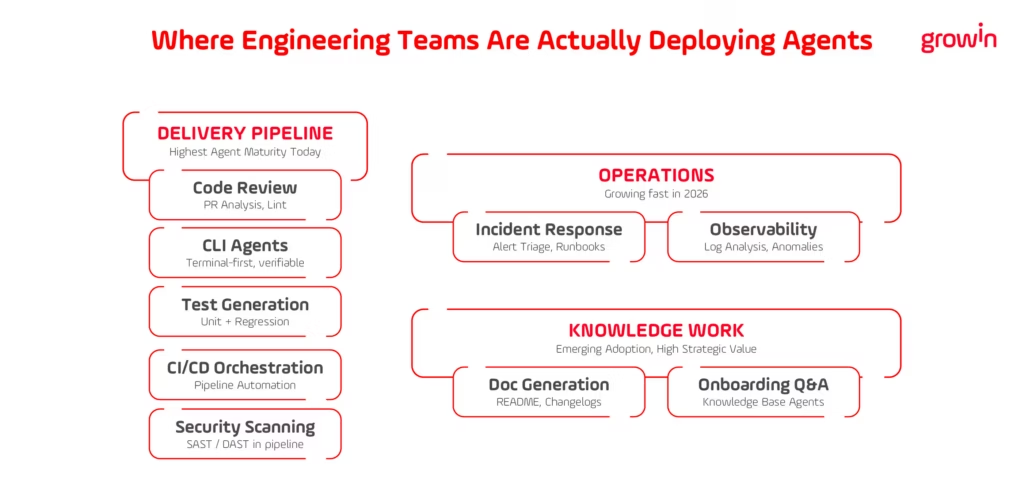
Not all deployment contexts are equal. The most successful early adoptions share a common trait: they happen in high-verifiability domains, where the output of an agent can be checked quickly and objectively. This is why CLI agents are gaining traction fastest — terminal-based tasks are the ideal entry point for AI agents in software development because they produce deterministic, auditable results that a human or another system can validate without ambiguity.
In practice, the use cases breaking through in 2026 cluster into three areas.
The delivery pipeline
The delivery pipeline is where agent maturity is highest, and for good reason. It is also the domain where the business case for AI agents in software development is easiest to prove — outputs are measurable, failures are visible, and the feedback loop is short. Code review agents that analyse pull requests for regressions, style violations, and security issues are now common in mature engineering organisations. Test generation agents that produce unit and regression tests from code diffs are close behind.
CI/CD orchestration is the natural next step — and the one most teams are actively piloting. An agent that manages pipeline state, handles failures, triggers rollbacks, and notifies the right people is the kind of high-frequency, rule-bound task where autonomy pays off quickly. Building that pipeline correctly matters as much as the agent on top of it: teams that invest in robust pipeline architecture from the start — covering real tools, GitOps practices, and rollback strategies — find that agentic layers integrate more cleanly than those bolted onto fragile infrastructure.
Security scanning within the pipeline is following the same trajectory. SAST and DAST agents that run as part of the delivery flow — rather than as separate audits — are shortening the feedback loop between code commit and vulnerability detection.
Operations
Incident response is the operations use case with the clearest ROI, and one of the faster-growing applications of AI agents in software development outside the delivery pipeline. SRE teams that have spent years managing alert fatigue are deploying agents to triage notifications, surface relevant runbooks, and draft first-response actions. The value is not replacing human judgment — it is removing the cognitive overhead that delays it.
Observability agents that scan logs, correlate signals across distributed systems, and surface anomalies before they become incidents are the next wave. These work best in teams that have already invested in structured logging and trace instrumentation, which is why observability infrastructure is increasingly being treated as a prerequisite for agentic deployments rather than a parallel initiative.
Knowledge work
Knowledge work is at an earlier stage but delivers high value where it lands. For many teams, it represents the next frontier for AI agents in software development — moving beyond execution tasks into the capture and distribution of institutional knowledge.
Documentation generation agents that write README files, changelogs, and API docs from code context are reducing one of the most consistently skipped tasks in engineering — and doing it without asking engineers to change their workflow. Internal Q&A agents trained on architecture decisions, runbooks, and onboarding materials are starting to meaningfully cut the time it takes a new hire to become productive.
The Production Gap: Why Most Pilots Don’t Scale
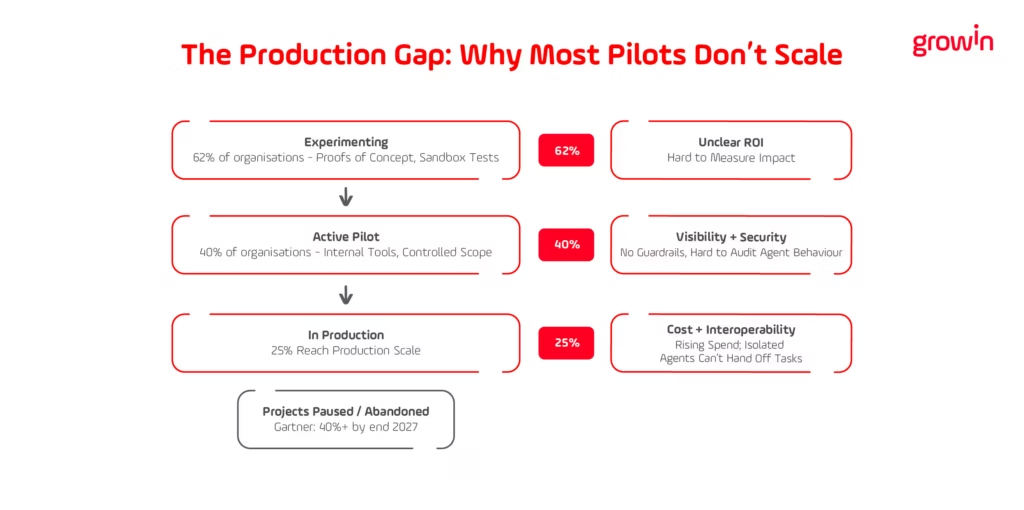
The 39-point gap between experimentation and production is not going away on its own. Gartner’s analysis suggests that by end of 2027, more than 40% of agentic AI projects in software development will stall or collapse — victims of rising costs, unclear business value, and insufficient risk controls. Understanding where AI agents in software development projects specifically break down is more useful than any general AI adoption framework. Four friction points account for most of the failure.
Visibility and control
As teams scale from one agent to many, the management model changes fundamentally. Developers stop writing code and start managing concurrency — setting boundaries on agent behaviour and debugging systems that make decisions autonomously. That demands new instrumentation. Teams must build logging, tracing, and observability into their agent pipelines from day one, not bolt them on after the first incident.
This connects directly to how platform engineering principles apply to agentic infrastructure. Embedding observability into the platform itself — rather than leaving it to individual teams — delivers the same discipline that has made internal developer platforms successful at scale. Growin’s analysis of the structural shifts driving platform engineering in 2026 is relevant context for any CTO thinking about agent infrastructure design.
Security
Gartner estimates that 25% of enterprise cybersecurity incidents will involve AI agent misuse by end of the decade — external attackers exploiting agent access on one side, agents behaving unexpectedly and creating exposure on the other. Sandboxing agent execution, enforcing least-privilege access, and treating agent credentials with the same rigour as human credentials are not optional. They are table stakes.
The security integration patterns that matter most here come from DevSecOps: embed security checks into the pipeline early, automate policy enforcement, and treat security as a continuous validation layer rather than a post-deployment audit. Teams that already run DevSecOps practices across their agile workflows find that extending those patterns to agentic pipelines is significantly more tractable than building security governance from scratch.
Cost
Parallel execution and background processing drive consumption up fast. Pricing models for AI coding agents are moving toward usage-based structures, and teams that deploy agents without clear cost instrumentation routinely find their infrastructure bill outpacing their productivity gains. Define cost-per-task baselines before scaling — this is an engineering discipline, not a finance formality.
The practical approach is to treat agent cost the same way mature engineering teams treat cloud cost: instrument early, set per-workflow budgets, and build alerting for anomalies before they compound. For AI agents in software development specifically, the highest cost surprises tend to come from agents running in loops — retrying failed tasks, pulling large context windows repeatedly, or spawning sub-agents without a clear termination condition. Building circuit breakers into agent workflows from day one is the single most effective cost control available, and it is also the one most teams skip until after their first unexpected bill.
Interoperability
MCP (Model Context Protocol) and A2A (Agent-to-Agent) are the two emerging standards that enable agents to share context, access tools, and hand off tasks across vendor boundaries — but adoption remains uneven. Agents that cannot communicate create hard ceilings on what multi-agent systems can accomplish. Ask your vendors which protocols they support before signing anything.
Understanding these patterns in the context of broader AI deployment practices matters too. The model reliability, monitoring, and rollback disciplines that MLOps introduced for machine learning systems apply directly to agent infrastructure — Growin’s guide to MLOps and AI deployment covers the foundational principles that translate most directly.
What This Means for Your Engineering Organisation
The practical implication for CTOs is not to move faster or slower. It is to move more deliberately.
Start in verifiable domains
CI/CD orchestration, automated testing, and code review are the right entry points for AI agents in software development — not because they are the most exciting, but because they produce outputs that can be checked objectively and quickly. That verifiability is what allows you to build trust in the system before extending autonomy. Starting in domains where failure is cheap and visible is how you build the institutional knowledge to expand into domains where it is not.
Instrument before you scale
The teams successfully scaling AI agents in software development treat agent behaviour the same way they treat application behaviour — with structured logging, trace IDs, alert thresholds, and defined failure modes. Retrofitting observability after deployment is significantly harder and more expensive than designing for it upfront. The DevOps KPIs that matter in agent contexts are not identical to traditional pipeline metrics — response time, task completion rate, and intervention frequency are the signals worth tracking from the start.
Rethink team structures before you need to
Agent orchestration is a new skill set. The engineers who will manage multi-agent systems need to think in terms of goals, context windows, tool permissions, and failure recovery — not just execution steps. This is one of the most underappreciated organisational shifts that comes with adopting AI agents in software development at scale. Building that capability while the pressure is low is a structural advantage. Waiting until a scaling mandate arrives from leadership means building it under time pressure, which is when the operational mistakes that create security incidents happen.
Stress-test your technology partnerships
Nearshore and staff augmentation arrangements that made sense in a world of human-only execution need to be evaluated against a world where agents are first-class team members. The question is not whether your partners use AI tools — it is whether they understand AI agents in software development deeply enough to design agent infrastructure responsibly and have the depth to build what your organisation will need 18 months from now.
The Question Is No Longer Whether — It Is How
AI agents in software development are already running in production pipelines at companies across every sector. They are already creating the productivity gains the market promised, and they are already creating the security incidents, runaway costs, and abandoned pilots that come with deploying autonomous systems without adequate governance.
The engineering leaders who are navigating this well are not the ones moving fastest. They are the ones that built the right instrumentation, started in the right domains, and treated agent deployment as an engineering discipline rather than a product experiment.
If you are ready to explore what agentic AI and intelligent automation could look like for your engineering organisation, we are building exactly that with teams across Europe.