
Every AI failure headline this year quotes the same 80% figure and stops there. What almost none of them mention is the cohort Gartner tracked separately — organizations where 71% of digital initiatives hit their targets, using the same AI tools as everyone else. The difference wasn’t the model. Here is what the verified 2024-2026 data actually shows about why AI failure happens and what the exceptions do differently.
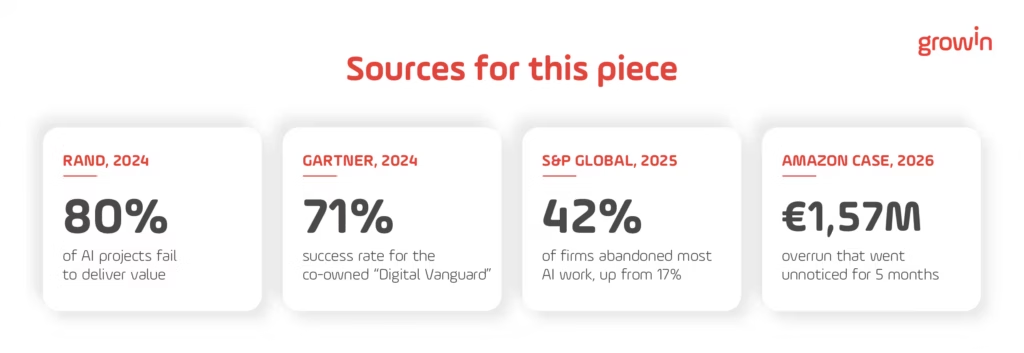
Eighty percent of AI projects fail to deliver their intended business value. That AI failure rate — the most-quoted AI failure statistic of the year — is everywhere — in vendor decks, in conference keynotes, in nearly every “why AI projects fail” article published since RAND Corporation’s research made the rounds. It’s real, it’s well-sourced, and repeating it alone doesn’t help anyone avoid becoming part of it.
What most of that AI failure coverage leaves out is the other half of the picture: a specific, measured cohort of organizations that doesn’t fail at this rate, tracked by a separate research firm using the same broad set of AI and digital tools as everyone else. The gap between that cohort and the rest isn’t a better model or a bigger budget, and understanding it matters more than memorizing the headline number — because the headline number, on its own, tells a decision-maker nothing about what to actually do differently on Monday morning.
What follows walks through six things the current, verified data makes clear about AI failure: how big the rate actually is and where it was measured, who the exception group is and what share of initiatives they get right, how fast abandonment is accelerating rather than slowing, what AI failure costs in euro terms most coverage never shows, what actually triggers a project’s cancellation, and what the high performers do differently that has nothing to do with which AI tool they picked.
The 80% AI failure figure has a real methodology behind it
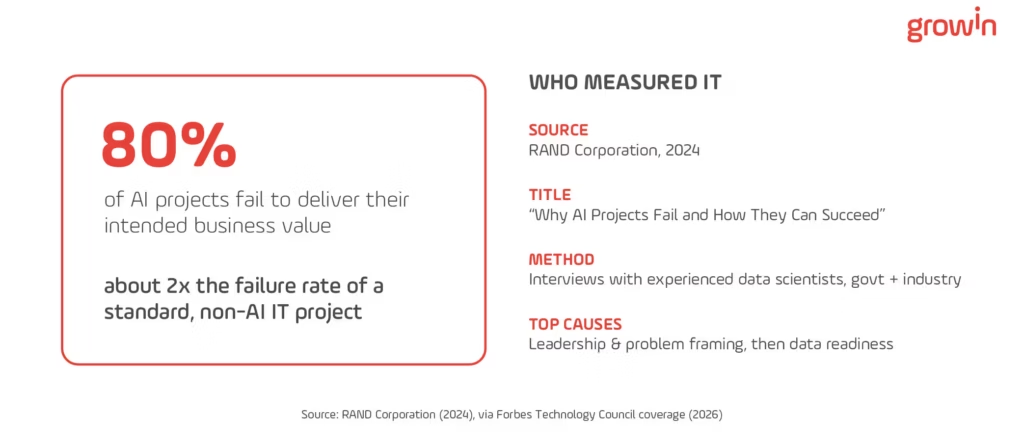
The AI failure rate did not originate as a vendor talking point. RAND Corporation’s 2024 report, “Why AI Projects Fail and How They Can Succeed,” is built on interviews with experienced data scientists working across government and industry. Its headline conclusion, since repeated everywhere from procurement memos to Forbes’ technology column, is blunt: roughly four out of every five AI projects never end up earning their keep.
It’s double the failure rate of a standard IT project
RAND’s comparison point matters more than the headline number. AI failure happens at roughly double the rate of ordinary, non-AI IT project failure — the same organizations running the same delivery processes see meaningfully worse outcomes specifically when AI is involved. That gap is the real story: it isn’t that these companies are bad at delivering software in general, it’s that something about how AI initiatives get scoped, owned and resourced is different, and worse. A failure rate that only shows up when AI enters the picture is a strong signal the problem sits in how AI work gets managed, not in software delivery generally.
The reasons trace back to people, not models
RAND’s own framing puts leadership and problem framing ahead of technology limitations as root causes of AI failure, with data readiness close behind — most enterprises underestimate the data preparation, lineage and governance work required before an AI use case is realistically deployable.
None of that is a modeling problem. It’s a staffing and process problem wearing an AI failure headline, and it’s exactly the kind of problem that gets easier to fix once you know that’s what it actually is rather than assuming the model needs replacing. Growin’s own guide to AI agents in software development covers the tooling side of this shift; this piece is specifically about the delivery and ownership side, which the data above suggests matters more.
A measured minority doesn’t see this AI failure rate
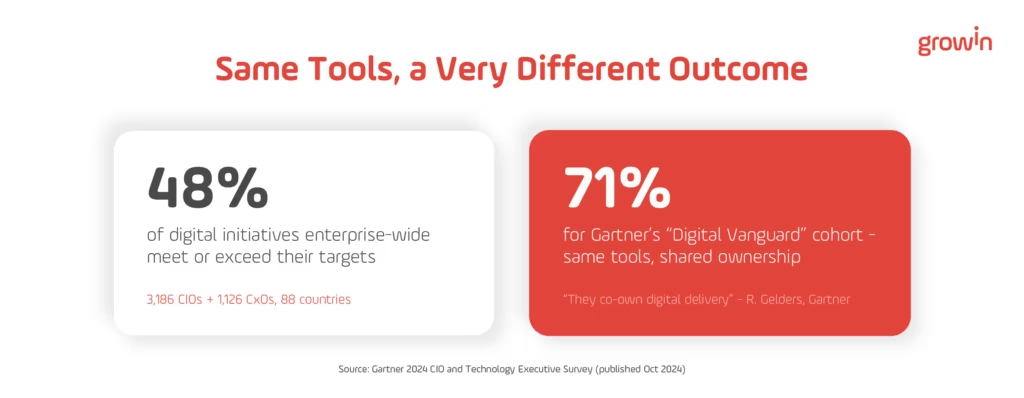
Not every organization posts AI failure numbers this bad, and the gap between the two groups is the real AI failure story. Gartner put this to the test in 2024, polling a combined 4,312 people — 3,186 sitting CIOs and other technology leaders, plus 1,126 executives from outside IT entirely, spread across 88 countries. What came back: only 48% of digital initiatives, enterprise-wide, actually hit or beat what the business expected of them. Buried inside that same survey is a second number worth more attention than the headline, and it points at the same underlying pattern as RAND’s AI-specific research.
Less than half of digital initiatives hit their targets
Fewer than half. That’s the base rate across a sample representing a combined $17.6 trillion in revenue and public-sector budgets — this isn’t a small or unusual group, and the AI failure pattern it describes tracks closely with RAND’s separate finding on AI specifically. Two independent research bodies, using two different methodologies, arrived at close to the same story: roughly half of ambitious technology initiatives miss their mark, whether or not AI is the specific technology involved.
The “Digital Vanguard” cohort hits 71%
Gartner identified a subset it calls the Digital Vanguard, where 71% of digital initiatives meet or exceed their outcome targets — nearly a 1.5x improvement over the average, and a rate that would make most AI failure statistics disappear if it applied broadly.
According to Gartner VP of Research Raf Gelders, what distinguishes this cohort is that they “co-own digital delivery” — CIOs and business executives share direct accountability for outcomes, rather than IT delivering a project a business unit merely sponsored from a distance. Same tools, same market conditions, same AI failure risk on paper, structurally different ownership model in practice — and a structurally different AI failure outcome as a result.
AI failure abandonment is accelerating, not slowing down
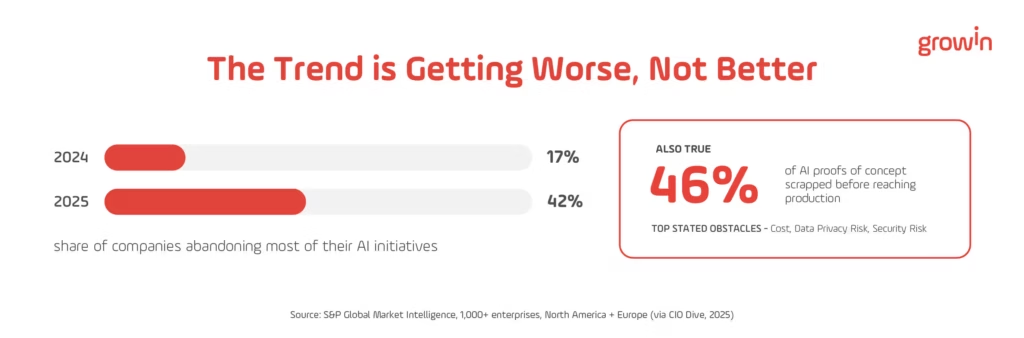
If AI failure were a temporary growing pain, the trend line would be improving. It isn’t. S&P Global Market Intelligence put the question directly to more than 1,000 enterprises across North America and Europe, asking how much of their AI work they’d actually walked away from in the past year. In 2024 that figure sat at 17%. A year later it had climbed to 42%.
The abandonment rate nearly tripled in a year
That’s not a modest uptick — it’s a company’s odds of walking away from most of its AI work roughly two and a half times higher than twelve months earlier, and it’s happening in the same window every vendor was promising the tooling had matured. The same research found that, on average, an organization never even got 46% of its AI pilots out of the testing phase and into a live system, meaning nearly half the work never gets a real chance to prove itself either way, let alone a chance to become an AI failure statistic on its own merits.
Cost and risk, not capability, are the stated reasons
When asked why, respondents didn’t point to the AI underperforming — they pointed to what it cost and what it exposed them to, naming budget overruns alongside data-privacy and security concerns as their biggest obstacles. That distinction matters for anyone building a business case: the thing killing these projects most often isn’t the technology falling short of expectations, it’s the organization around it not being ready to govern what it built.
An AI failure driven by ungoverned cost is a solvable problem before the project starts; an AI failure driven by the model simply not working is a much harder one, and the data above says the second kind is the less common of the two. That’s worth repeating to any board asking whether the answer is a different vendor: the evidence says the answer is usually a different process, applied to whichever vendor was already chosen.
AI failure has a euro figure most coverage never shows
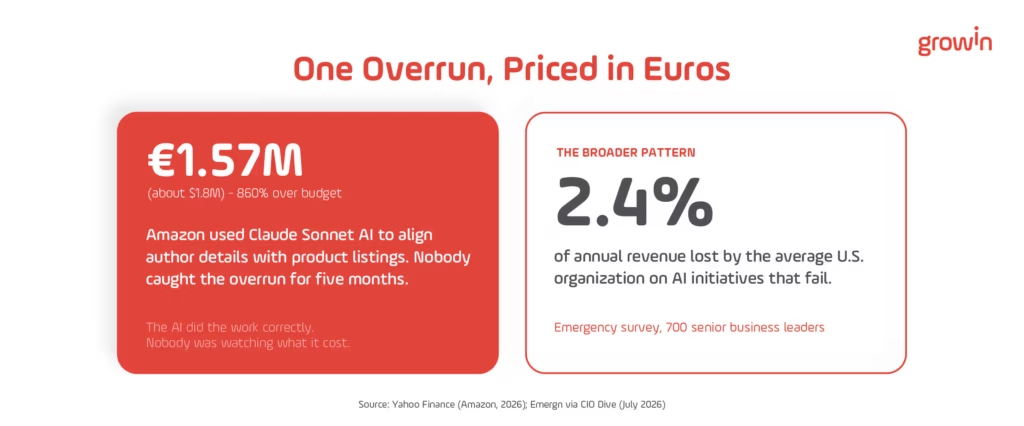
Abstract failure rates are easy to nod along to. A concrete overrun is harder to ignore, and Amazon’s own internal experience — reported by Yahoo Finance — is one of the more fully documented examples of what AI failure actually costs in practice, and it’s worth pricing in euros since that’s the currency any European finance team will actually be budgeting against.
Amazon’s task went 860% over budget for five months, unnoticed
Amazon put Claude Sonnet AI to work matching up author names with the right book listings on its retail site — a housekeeping task, not a moonshot. The task ran 860% over its expected cost — reaching roughly €1.57 million (about $1.8 million) — and nobody inside the company caught it for five months. This wasn’t a failed model output; the AI did the work correctly. Nobody had a process watching what it cost to get there, which is a materially different kind of AI failure than the model simply being wrong.
The average enterprise loses 2.4% of annual revenue this way
Emergn, a technology and management consultancy, surveyed 700 senior business leaders and found U.S. organizations lose an average of 2.4% of their annual revenue on AI initiatives that fail to deliver their expected value. For a mid-size European enterprise turning over €200 million a year, that 2.4% is roughly €4.8 million — not a rounding error in the AI budget, but a material line on the income statement that traces back to projects nobody was watching closely enough.
Cost surprises are now what triggers AI failure
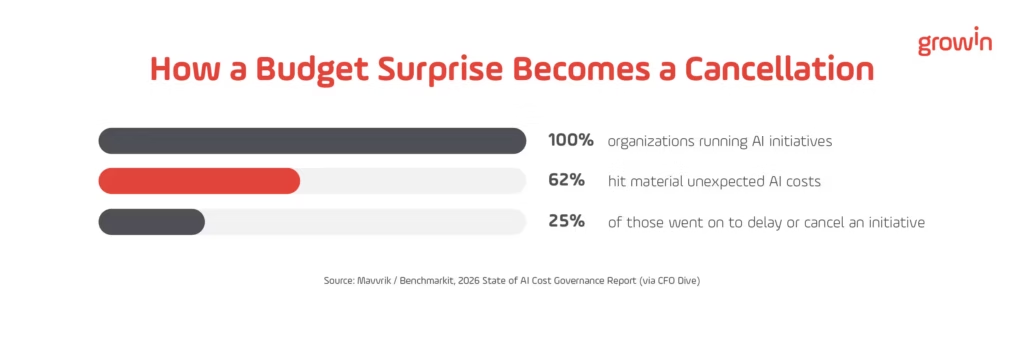
The pattern connecting the abandonment data and the Amazon-style overruns is specific: it’s the moment cost surprises leadership, not the moment the AI underperforms, that most often ends a project.
Most organizations are already over budget on AI
Mavvrik’s 2026 State of AI Cost Governance Report put a number on how many organizations get blindsided by their own AI budget: 62%, close to two in three. That’s a majority discovering mid-project that what they budgeted for wasn’t what the work actually required, which is exactly the position Amazon was in for five straight months without knowing it.
A quarter cancel or delay once that surprise lands
Of that group — the ones who got hit with a bill they didn’t see coming — one in four ended up pulling the plug or pushing the project back entirely, which makes an unwatched budget one of the single biggest predictors of AI failure in the data above. Put together with Amazon’s five-month blind spot, the throughline is the same: AI failure most often isn’t a verdict on the technology, it’s a verdict on whether anyone was accountable for tracking what the project cost against what it was supposed to deliver, in real time rather than in a retrospective months later.
What the 71% actually does differently
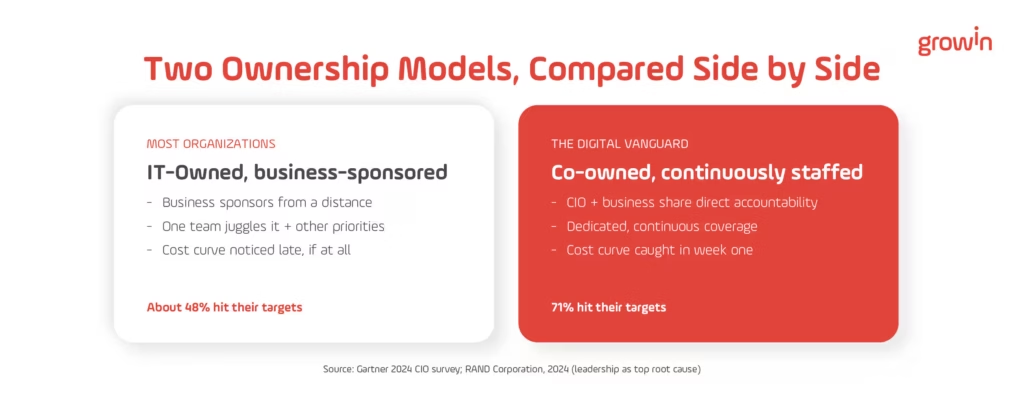
None of the data above points to a better model as the fix for AI failure. It points somewhere more specific: toward who owns the project once it leaves the pitch deck, and stays owning it through the unglamorous months where a cost curve either gets caught early or doesn’t.
Gartner’s Digital Vanguard cohort didn’t get to 71% with access to different AI, they got there by making delivery a shared, accountable responsibility between IT and the business, instead of an IT-owned initiative the business merely sponsored from a distance. That single structural difference tracks with RAND’s own diagnosis that leadership and problem framing, not technology, are the leading root causes of AI failure. It also tracks with the S&P Global and Mavvrik findings above: the organizations getting surprised by cost and abandoning projects are, functionally, the ones without anyone clearly accountable for watching either number until it was too late.
Ownership is a staffing decision before it’s a technical one
That’s answerable before a project starts rather than after it’s already 860% over budget. A named, accountable owner isn’t a checkbox on a project charter — it’s a person or a team with enough continuous time on the initiative to notice a cost curve bending the wrong way in week one, not month five.
Most organizations don’t lack that person because nobody in the building is capable of the role; they lack them because that person is already covering three other priorities and AI delivery ownership becomes the fourth thing nobody quite owns. Ask any team that’s lived through an AI failure post-mortem and the same sentence tends to come up: someone technically owned it, but nobody had the bandwidth to actually watch it. That gap between nominal and actual ownership is, in practice, most AI failure in one sentence.
The AI failure gap closes faster than the skills gap does
Hiring a permanent, dedicated AI delivery owner takes months most projects don’t have, and the Digital Vanguard pattern doesn’t require a permanent hire to replicate — it requires continuous, accountable coverage for the length of the initiative. That’s a meaningfully different resourcing problem than “find and hire the right person,” and it’s the one most stalled AI initiatives are actually stuck on. It’s also the same underlying resourcing problem Growin’s nearshore teams guide for CTOs addresses for engineering delivery generally — AI initiatives just make the cost of getting ownership wrong visible faster and in bigger numbers.
Reducing your odds starts before the project is scoped
A dedicated software team built around a specific AI initiative gives it the same kind of continuous ownership Gartner’s Digital Vanguard cohort has internally — someone accountable for the work who isn’t juggling it alongside four unrelated priorities. For organizations further along, Growin’s intelligent automation practice integrates AI and generative AI into process optimization and custom development with the delivery discipline that separates the 71% from everyone else, informed by the same AI FinOps cost governance thinking that could have caught Amazon’s overrun in week one rather than month five. Where the gap is specifically capacity rather than a new build, IT staff augmentation brings in the accountable owner a stalled initiative is usually missing, without a full re-scope.
None of these are alternatives to picking a good AI tool — they’re what determines whether the tool you already picked gets a fair chance to prove itself before someone decides, six months in, that the AI failure was a technology problem all along. Growin’s team has spent over a decade building the kind of engineering depth that makes continuous ownership possible, across banking, energy and travel clients who can’t afford to find out about a cost overrun five months late.
Every AI failure story eventually gets written up as a lesson about the technology. Most of them, on closer reading, are actually lessons about who was supposed to be watching — and for how long they were supposed to keep watching after the first demo went well. That’s the question worth asking before the next AI initiative gets a green light, not after it’s already become one more entry in next year’s failure statistics.
The 80% figure will keep getting quoted on its own, because it’s the more dramatic half of the story. The organizations avoiding AI failure are the ones who read the other half — and treated who owns delivery as the actual decision, not an afterthought to which model to buy. Get in touch to talk through what accountable delivery would look like for your next AI initiative.