Every company weighing how to add engineering capacity ends up comparing the same handful of models: a farshore team on the other side of the clock, an in-house hire, a freelancer sourced directly off a marketplace, or a nearshore team close enough to overlap a real workday. The comparison usually gets framed as a tradeoff between cost and quality, with nearshore alternatives positioned as cheaper or more flexible and nearshore itself positioned as the safer, pricier one. The research says the actual tradeoff is narrower and more measurable than that.
A 2024 study of more than 12,000 employees at a large multinational found that real-time, synchronous communication drops by an average of 11% for every additional hour of time-zone distance between two people working together. That single mechanism explains a large share of what separates nearshore outcomes from its alternatives.
Six findings below walk through what that mechanism actually costs across the main nearshore alternatives: where farshore outsourcing still makes sense despite it, and what in-house hiring and freelance marketplaces get right and wrong by comparison. None of this is an argument that every one of the nearshore alternatives is a mistake. It’s an argument that the comparison deserves a real mechanism behind it, not a hunch about culture or a line item on an invoice.
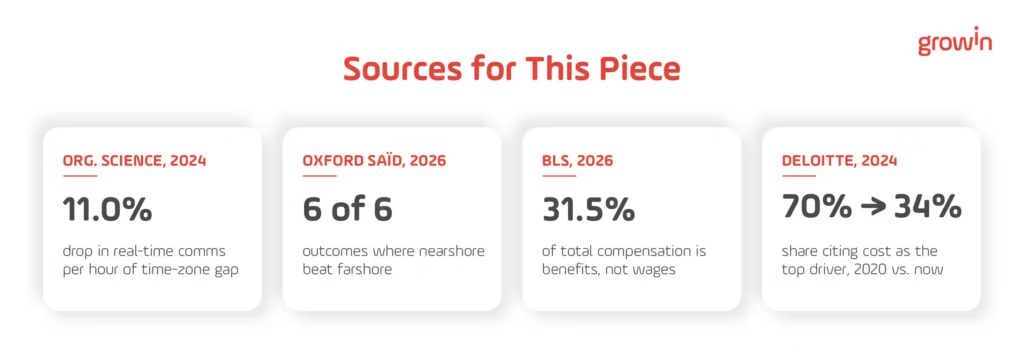
Every hour of time-zone distance costs about 11% of real-time communication
Before comparing nearshore alternatives on outcomes, it helps to understand the one variable driving most of the difference between them. Every one of the nearshore alternatives discussed in this piece involves some amount of time-zone distance, even in-house hiring once remote work is part of the picture, which makes this the right place to start.
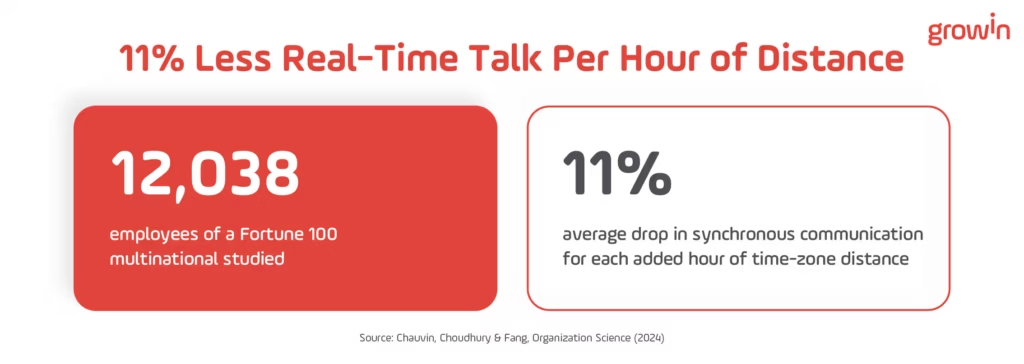
A study of 12,000+ employees put a number on what distance actually costs
Published in Organization Science in 2024, the study analyzed communication-level data from 12,038 employees of a large multinational firm across 167 cities in 48 countries, using shifts to and from daylight saving time to isolate the effect. The researchers found that an approximately one-hour increase in temporal distance reduces the volume of synchronous communication (calls, meetings, real-time messages) by an average of 11.0%. That’s the clearest single number available for comparing nearshore against farshore, because it isolates time-zone distance from every other variable — culture, language, tooling, contract type — that normally gets blamed instead when a nearshore–farshore comparison goes badly.
The effect is real but not uniform across every kind of work
The same study found no statistically significant drop in synchronous communication among employees doing nonroutine work or in strong collaborative relationships. Those pairs compensated by shifting their own hours to stay in sync, working earlier or later than their local norm. The 11% figure is an average, not a universal tax, and it matters most for routine, loosely connected work where neither side has much reason to bend their schedule.
That distinction matters for how a company evaluates nearshore alternatives. For collaborative, judgment-heavy work, distance doesn’t stop communication. It moves it into early mornings and late evenings, and someone on the team absorbs that cost personally. For routine, loosely connected work, communication genuinely drops, but that work needed less of it to begin with. The same study also found that employees in countries with stricter legal limits on working hours time-shift significantly less, which matters for European teams in particular: they are less likely to absorb a distant partner’s schedule on their own time.
That mechanism shows up directly in project outcomes
If time-zone distance measurably reduces real-time communication, the next question is whether that reduction actually changes what gets delivered. A separate study set out to answer exactly that, comparing nearshore against farshore directly on the outcomes that actually matter to a buyer.
Nearshore engagements scored significantly better across five separate outcomes
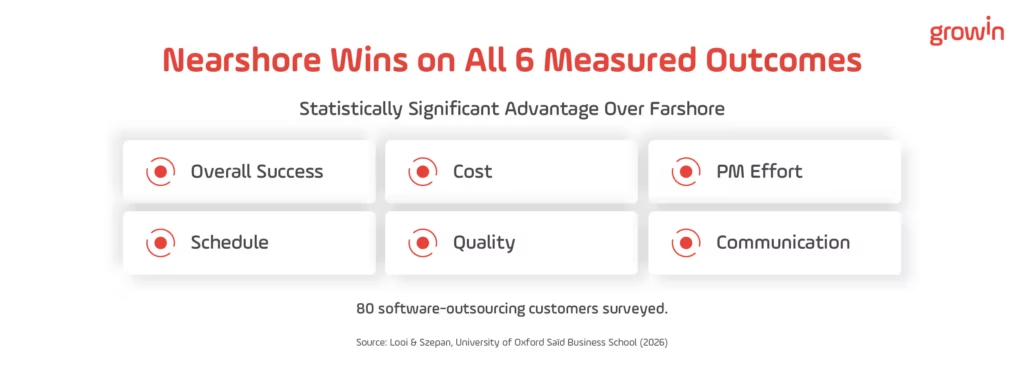
A 2026 study by researchers at the University of Oxford’s Saïd Business School, covering 80 software-outsourcing customers with follow-up interviews, found nearshore locations produced statistically significant advantages over farshore ones on overall project success, project management effort, schedule adherence, quality, and communication problems. Five separate outcomes moved in the same direction, which is a harder pattern to produce by chance than a single favorable metric would be, and it’s a rare case of a head-to-head comparison that didn’t come back mixed.
The sample is real but modest, and the authors say so themselves
Eighty customers is a meaningful sample for a survey of this kind, not a definitive one, and the paper’s own authors frame it as evidence to weigh rather than a verdict to accept uncritically. What makes it useful here is that its findings point the same direction as the much larger, separately conducted Organization Science study above. That’s two independent pieces of research, run by different teams on different populations, converging on the same mechanism from different angles. That’s a stronger basis for comparing these models than either study would be on its own.
Farshore is a nearshore alternative suited to a narrower set of tasks
None of this makes farshore, the most distant of the nearshore alternatives, a bad choice in every case. It makes it a choice that fits a narrower set of circumstances than a pure cost comparison would suggest, and treating it as a universally worse option than nearshore would be just as much of an overreach as treating cost savings as the only variable that matters.
Well-specified, loosely coupled work is where the 11% matters least
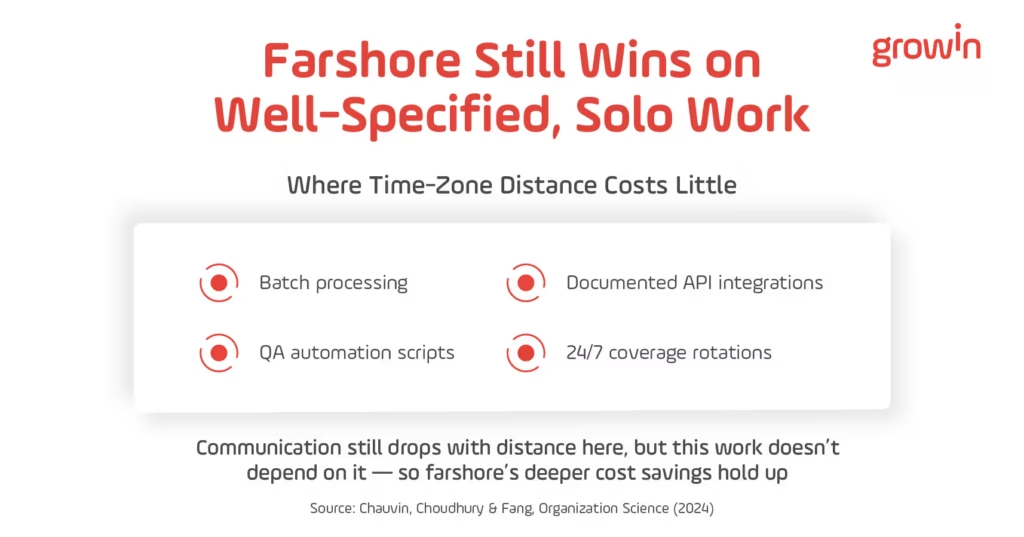
The same Organization Science finding cuts both ways. For clearly specified, independent tasks with minimal back-and-forth, communication does drop with distance, but the work was never going to need much synchronous back-and-forth in the first place. Batch processing, QA automation scripts, well-documented API integrations, and 24/7 coverage rotations are exactly the kind of work where a wide time-zone gap costs little. Among the nearshore alternatives a company might weigh, this is the category where farshore consistently makes the most sense, and no amount of nearshore marketing copy should talk a team out of it when the work genuinely fits.
The deepest cost savings still sit with farshore, when the work fits
Nearshore alternatives exist because they genuinely solve a different problem than nearshore does. A farshore arrangement built around well-defined, independently gradable work units can still deliver real savings without hitting the communication friction this piece is built around, precisely because that kind of work was never depending on real-time collaboration to succeed.
Dismissing farshore outright because of the findings above would be the same mistake as ignoring them. It just runs in the opposite direction, and it’s just as costly for a team that genuinely has the right kind of work for it. The honest version of this piece isn’t “nearshore always wins.” It’s “nearshore alternatives each have a real job to do, and farshore’s job is cost efficiency on work that doesn’t need daily collaboration to succeed.”
In-house costs more than the salary line suggests
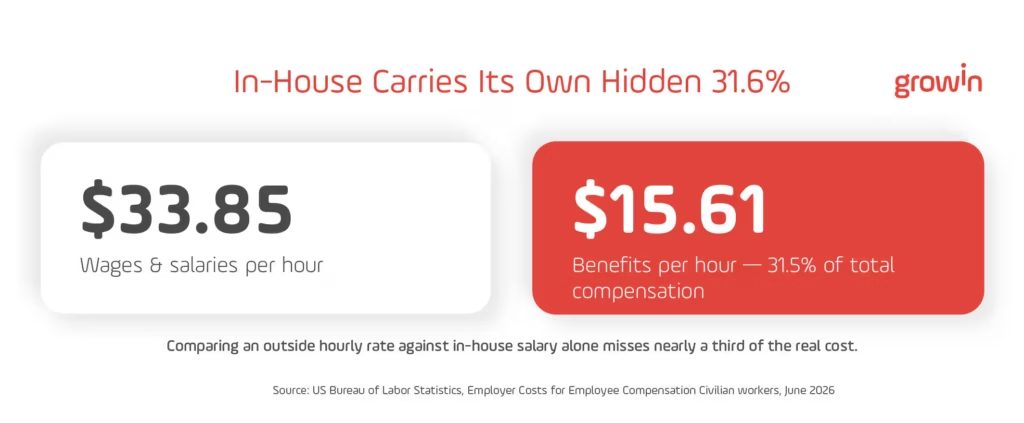
Of all the nearshore alternatives, an in-house hire is the one nearshore gets compared against most often, and that comparison usually stops at the wrong number. It’s worth fixing before any of the other findings in this piece can be applied fairly.
Benefits alone add roughly 46% on top of an in-house salary
The US Bureau of Labor Statistics’ Employer Costs for Employee Compensation release, for full-time private-industry workers as of June 2026, found benefits make up 31.5% of total compensation, which works out to roughly 46% on top of base salary. An in-house hire priced only on salary is being compared against nearshore’s hourly rate using a number that captures only about two-thirds of the real cost, before recruiting costs or the weeks a role typically sits open even enter the picture. Fixing that comparison doesn’t require picking a side. It just requires pricing every option the same honest way.
In-house still wins on long-term ownership, which nearshore doesn’t claim to replace
None of this argues against in-house hiring where it actually matters most: core product ownership, long-term institutional knowledge, and work where handing context to an outside team costs more than it saves. The same build-versus-partner logic shows up at a larger scale too, in the decision between standing up a dedicated delivery center and partnering with an outside team.
Outside teams aren’t a universal substitute for a permanent team any more than a permanent team is a universal substitute for flexible outside capacity. They solve different problems, and the the honest comparison of nearshore alternatives starts by being clear about which problem is actually being solved, before any hourly rate or salary figure enters the conversation at all.
DIY freelance marketplaces solve availability, not management overhead
The fourth of the nearshore alternatives isn’t farshore or in-house at all. It’s sourcing individual contractors directly off a freelance marketplace and managing the engagement internally. It’s worth treating as a distinct option rather than folding it into “outsourcing” generally, because the tradeoffs involved look almost nothing like farshore’s, and lumping all nearshore alternatives together is how a lot of these comparisons go wrong in the first place.
The independent talent market this draws from is large and still growing fast
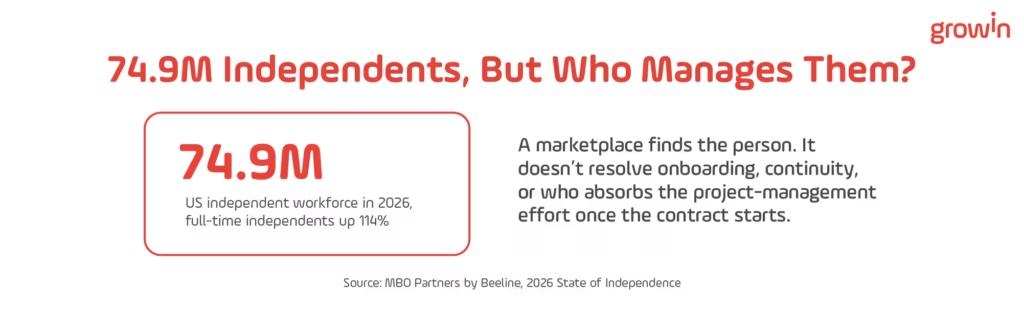
MBO Partners by Beeline’s 2026 State of Independence report found the US independent workforce reached 74.9 million people in 2026, with full-time independent professionals growing 114% since 2020. This isn’t a fringe sourcing channel. It’s a large and fast-growing one, which is exactly why the comparison to nearshore is worth making carefully rather than dismissing either option outright. Among all the nearshore alternatives in this piece, a direct-to-marketplace hire is the one most likely to look identical to nearshore on paper, right up until someone has to manage it.
What a marketplace doesn’t solve is who manages the handoffs
A marketplace finds the person. It doesn’t resolve who runs onboarding, who owns continuity when a contractor’s engagement ends, or who absorbs the project-management effort the Oxford study found was lower with nearshore vendors than farshore ones. That work still has to happen somewhere, and sourcing a contractor directly just moves the question of who does it from a vendor’s team onto the client’s own, without necessarily making the handoffs that caused the project-management burden in the first place any smaller.
Of all the nearshore alternatives considered here, this is the one where the real cost is least visible at the moment of hiring and most visible three months in, once the person who sourced the contractor realizes they’re also the one managing them.
Cost is no longer the main reason buyers are choosing between these models
Put the first five findings together and a practical question follows: if the communication mechanism is real and measurable, why do so many comparisons between these models still get framed as a pure cost decision? The buyers who’ve actually run comparisons across these models for years have been moving away from that framing, which suggests the market has already absorbed a version of the lesson this piece is making explicit.

The share of executives citing cost as the top driver fell from 70% to 34%
Deloitte’s Global Outsourcing Survey, covering more than 500 executives globally, found the share citing cost reduction as their top outsourcing priority fell from 70% in 2020 to 34% today. Skilled talent and agility have joined it as the leading reasons companies choose one model over another, which tracks with everything the communication research above would predict about which models actually hold up once quality, not price, is the thing being optimized for.
The real gap is governance maturity, not which model gets picked
The same survey found 70% of executives report their vendor management function isn’t fully mature, and only 25% are seeing clear reductions in vendor costs or improvements in service quality from their current arrangements. That gap has less to do with whether a company picked nearshore, farshore, in-house, or a freelance marketplace, and more to do with whether anyone built the governance to manage the choice well once it was made. Among all the models compared in this piece, the ones that under-deliver most often aren’t failing because of the model. They’re failing because nobody built the muscle to run it.
That reframes what actually separates a successful engagement from a disappointing one across every model covered here, and it’s a more useful question than “which of these models is cheapest” turns out to be in practice. A farshore team run with disciplined async handoffs can outperform a nearshore team run without structure. A freelance marketplace hire managed with clear onboarding can outperform an in-house hire left to figure things out alone. The model sets the starting conditions. The governance built around it decides most of what happens next, which is exactly the variable a cost-only comparison between models leaves out entirely.
What this means for teams weighing nearshore alternatives
None of the six findings above argue that nearshore is right for every engagement, or that every one of its nearshore alternatives is a worse default. Farshore outsourcing remains the better economic choice for well-specified, loosely coupled work. In-house hiring remains the right call for core product ownership. Freelance marketplaces remain a fast, legitimate way to reach a large and growing pool of independent talent for short, self-contained work. Each of these nearshore alternatives earns its place in the comparison on its own terms, not as a lesser option being ruled out by default.
What the research does argue is that comparing nearshore alternatives shouldn’t start and end with hourly rate. An 11% drop in synchronous communication per hour of time-zone distance is a measurable, consistent mechanism, not a cultural generalization, and it shows up in the same direction across a separate, independently run study of actual project outcomes.
For work that depends on daily collaboration, real-time problem-solving, and tight feedback loops, that mechanism is the real cost nearshore alternatives are trading away, whether or not it shows up on the invoice. And for work that doesn’t depend on any of that, the same mechanism barely applies at all, which is exactly why a single answer to “which of these models is best” was never going to hold up across every kind of engineering work a company actually staffs.
The practical version of this is simple enough to apply before the next staffing decision gets made: name what kind of work is actually being staffed first, then pick from among the models on the table based on which one fits that work, rather than starting from a hiring model and hoping the work adapts to it.
Most teams do it backward, and most of the disappointing outcomes blamed on one model or another trace back to that order, not to anything specific to nearshore, farshore, in-house, or freelance work on its own. Fixing the order a company asks these questions in costs nothing and changes the odds of the decision holding up a year later.
The specific questions worth asking before signing with any nearshore partner are a natural next step once the model itself has been chosen. For teams in the UK and Western Europe, Growin’s Portugal-based teams sit zero to one hour away, which is about as close to no penalty as this research gets. Talk to Growin about which of these models actually fits the work in front of your team, not just the one with the lowest hourly rate.