A look at why cost stopped driving outsourcing decisions, what the growth data shows once Europe and cloud infrastructure spending are separated out, and what clients want from a partner instead.
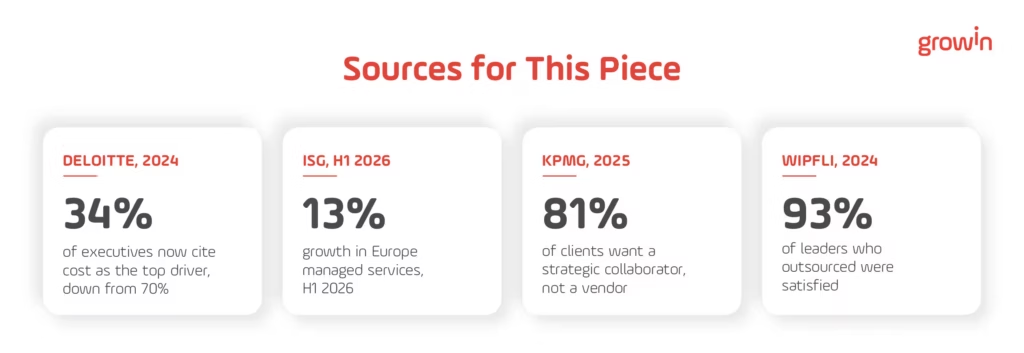
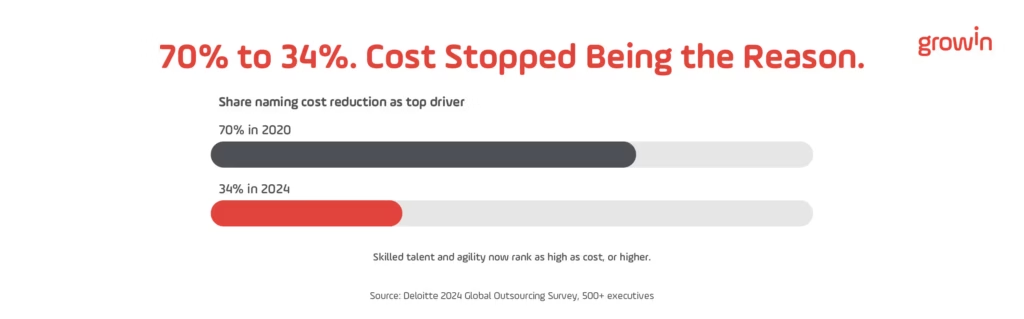
Ask most people why a company turns to outsourcing and the answer is still “it’s cheaper.” That answer is out of date. Deloitte’s 2024 Global Outsourcing Survey, polling more than 500 executives, found cost reduction as the primary driver fell from 70% in 2020 to 34% today, with skilled talent and agility now joining it as leading reasons to outsource.
That’s a different reason to buy. A company shopping on cost is comparing rates. A company shopping for talent access or speed is comparing whether a partner can actually supply a capability it doesn’t have time to build in-house.
Six findings below look at what’s actually changed, where the growth in outsourcing is concentrated, and what that means for a company choosing between rate cards and specialists. None of it argues the model is shrinking. It argues the model that’s winning looks less like generic capacity and more like a specialised, long-term partnership.
Cost reduction stopped being the top reason to buy
For most of outsourcing’s history, the business case started and ended with the rate card. That’s no longer how most buyers frame the decision, and the shift shows up clearly in how executives describe their reasons for outsourcing today. It also changes what a partner needs to prove before a contract gets signed.
The primary driver dropped by half
Deloitte’s survey found the share of executives naming cost reduction as their primary outsourcing driver dropped from 70% in 2020 to 34% today, with skilled talent and agility joining it as leading drivers. A buyer chasing talent access is comparing something harder to fake than a rate: whether a partner can supply a specific capability on a timeline that matters.
Buyers are managing the relationship, not walking away
That doesn’t mean trust in outsourcing is unconditional. The same survey found 70% of executives have selectively insourced some previously outsourced scope over the past five years. Deloitte is explicit that this is happening alongside continued investment, not instead of it: 80% of executives plan to maintain or increase their third-party outsourcing spend. Buyers are managing these relationships deliberately rather than committing blindly either way, which is exactly the kind of scrutiny a specialised partner should welcome.
Growth looks different once Europe is separated from global cloud spending
The outsourcing market’s headline growth numbers look strong in 2026, but they mix very different kinds of spending together. Separating cloud infrastructure from engineering services, and Europe from the global total, gives a clearer picture of where demand for outsourcing partners is actually moving.
Global growth is mostly cloud infrastructure, not engineering services
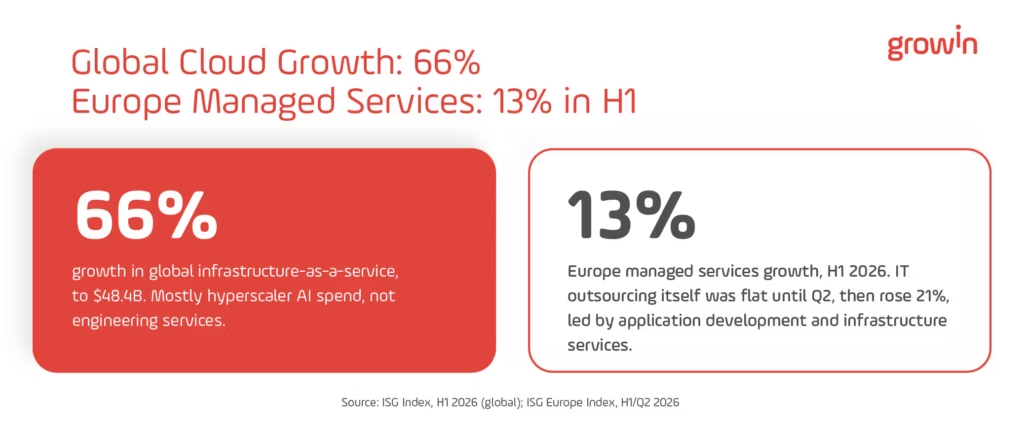
The headline outsourcing numbers for 2026 are strong, but the strongest part of them isn’t engineering services. ISG’s Index found the global technology services market grew 35% in H1 2026, but that figure is driven mainly by infrastructure-as-a-service, up 66% to $48.4 billion. That’s largely hyperscaler cloud spending on AI infrastructure, not money flowing to engineering-services providers. Global managed services, the category closer to what Growin actually does, grew a much more modest 2.7%.
Europe’s managed-services and ITO numbers tell a different story
The picture is better in Europe, though not evenly so. ISG’s Europe data found managed services grew 13% across the first half, to $9.3 billion, but most of that came from business process outsourcing, which surged 86%. IT outsourcing itself, the category closer to what Growin does, was essentially flat across the half, down 0.2%. It moved in the second quarter specifically, rising 21% to $3.2 billion, led by application development and maintenance and infrastructure services. One strong quarter isn’t a confirmed trend, but it’s a specific, named recovery in exactly the kind of work Growin delivers, not a general one.
The growth inside outsourcing is tilting toward specialisation
Growth inside outsourcing isn’t spread evenly across providers. ISG’s research points to a market splitting in two directions at once, and that split says a lot about which kinds of partners are gaining ground and which kinds of work AI is putting under pressure.
Enterprises are splitting between consolidation and niche providers
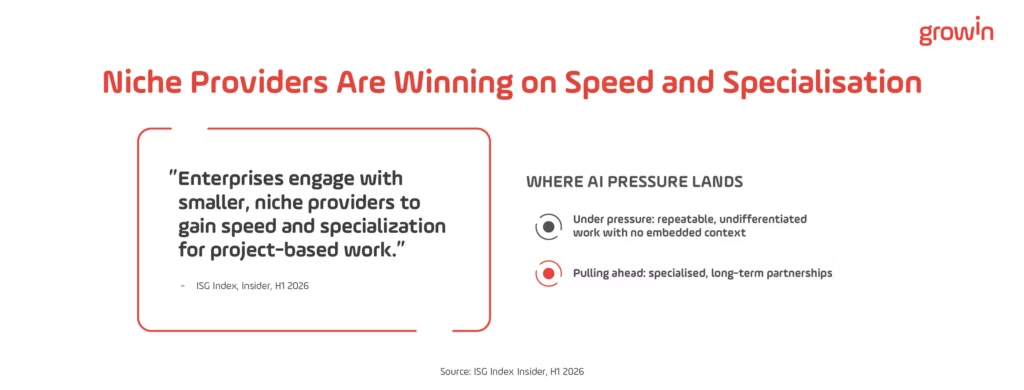
ISG’s own research explains why global managed services growth stayed muted while specific segments pulled ahead, and the explanation favours specialists over generic capacity. Enterprises are consolidating some providers into larger, longer cost-takeout deals, and separately, in ISG’s own words, choosing to “engage with smaller, niche providers to gain speed and specialization for project-based work.”
What AI is actually displacing
That split matters for how a company reads the rest of ISG’s data. ISG has also flagged AI as a headwind for managed services, citing concerns about how it will affect labour-centric tech services. Read on its own, that sounds like a threat to any staffing model. Read against the niche-provider finding above, it’s a threat to a specific kind of engagement: repeatable, undifferentiated work with no real context or relationship behind it.
ISG’s own point is about project-based work specifically, but the same logic plausibly extends further: a dedicated team that’s been embedded with a client for years, understands the codebase and the business, and keeps learning alongside it looks less like the generic capacity AI is substituting for, and more like the specialised, differentiated work ISG says is pulling ahead.
Clients increasingly want a strategic collaborator, not a vendor
If cost is no longer the main reason to outsource, the next question is what buyers expect from a partner instead. KPMG’s research answers that directly, and the answer describes a different kind of relationship from the one most outsourcing contracts were originally written for.
Two KPMG figures, one direction
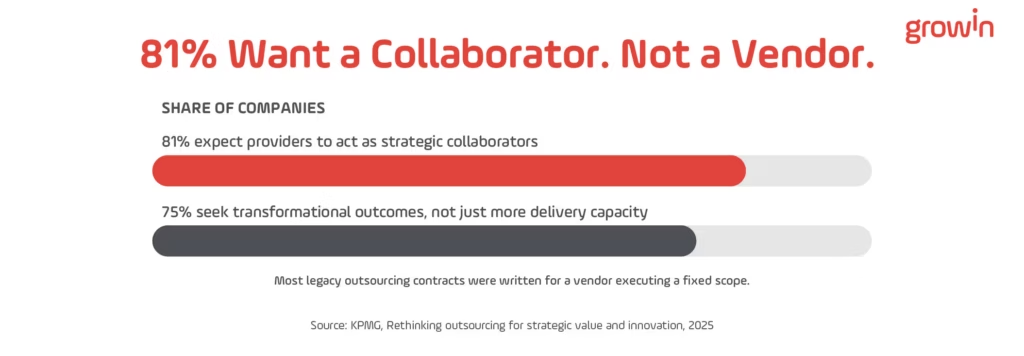
KPMG’s research found 81% of companies now expect their outsourcing providers to act as strategic collaborators rather than vendors executing a fixed scope, and 75% are seeking transformational outcomes rather than simply more delivery capacity. The direction is consistent with everything else in this piece: buyers want a partner who understands the business, not a line item.
The difference between a collaborator and a vendor
A strategic collaborator pushes back on a bad requirement and brings context from other engagements into the conversation. A vendor executing a fixed scope is specifically not expected to do either. Most legacy outsourcing contracts were written for the second relationship, not the first.
Existing outsourcing relationships already work
A shift in buying criteria could be read as a sign of dissatisfaction, but the data points the other way. Companies that already outsource are broadly happy with the results, which suggests the change is about what buyers want next, not about outsourcing failing to deliver.
What Wipfli’s survey actually measured
Wipfli’s Outsourcing Trends Report, published in August 2024 from a survey of 360 C-suite leaders, found 72% have outsourced some part of their business, with technology work grouped alongside finance and accounting as the most commonly outsourced functions. The survey covers outsourcing broadly rather than software specifically, so it’s a read on sentiment rather than a software-outsourcing adoption curve, but the sentiment itself is useful.
Satisfaction once a company commits
Of the leaders who had outsourced, 93% said they were satisfied with the experience. That’s not proof the remaining share who haven’t tried it are missing out on software outsourcing specifically, but it does rule out a straightforward explanation: whatever is holding wider adoption back, it isn’t outsourcing itself under-delivering once a company commits to it.

Many companies adopted AI without redesigning how people work with it
AI is the newest pressure on how companies staff engineering work, and adoption is already widespread. What’s less widespread is the harder step of changing how teams actually work around it, and that gap is where an outsourcing partner can add the most value.
Adoption without redesign

Deloitte’s State of AI in the Enterprise, 2026, surveying 3,235 business and IT leaders across 24 countries, found more than a third of organisations, 37%, are still using AI at only a surface level, with little or no change to how the underlying work actually gets done. Another 30% are redesigning key processes, and 34% report deeply transforming products, processes, or business models around it.
Why that gap favours an embedded partner
That surface-level third is a capability gap, not a tooling gap: handing someone an AI tool without rethinking the workflow around it doesn’t change outcomes. Separately, Deloitte found only 25% of organisations have moved 40% or more of their AI experiments into production, though 54% expect to reach that level within the next three to six months. Closing the gap between adopting a tool and actually changing how work gets done, at whatever stage an organisation is at, is exactly what a long-term, embedded partner is positioned to do alongside a client, rather than handing over a licence and leaving.
What this means for an outsourcing decision
None of the six findings above point to a shrinking market. They point to a market where the easiest money, generic capacity sold on price, is getting harder to compete on, while demand for specialised, long-term, context-rich partnerships is picking up in exactly the places ISG’s own data shows: in Europe, in application development and maintenance, where Q2 marked an early recovery, and in the niche-provider segment ISG says enterprises are actively seeking out.
That’s the model Growin has built around from the start: dedicated nearshore teams who stay with a client long enough to actually understand the business, backed by continuous learning rather than a static skill set, so the relationship gets more valuable over time instead of staying a fixed-cost line item. Talk to Growin about what that kind of partnership looks like for your own team.