
The nearshore model is compelling on paper. Timezone alignment with your team. Engineers working within Western European cultural norms. Costs significantly below onshore hiring — senior full-stack engineers in Portugal typically earn €45k–€75k compared to £95k+ in London or €90k+ in Berlin. Access to a talent pool that, in Portugal alone, now counts over 262,000 ICT professionals and continues to grow at one of the fastest rates in Western Europe. The model works. The question is whether your specific engagement will.
Between 20 and 25% of outsourcing engagements fail to meet their objectives — not because of bad developers, but because the wrong questions were asked too late, or not at all. The difference between a nearshore partnership that compounds value over time and one that quietly becomes a second engineering organisation with unclear ownership tends to come down to five conversations that most teams either skip or have too superficially before signing.
This guide is not a checklist for catching out a bad vendor. It is a framework for recognising a genuinely good partner — and understanding what to expect from them before the engagement begins.
Why Nearshore Fails — When It Does
The model gets chosen before the work is understood
The most common pattern behind underperforming nearshore engagements is simple: the model was chosen out of habit rather than fit. Staff augmentation is familiar, so it becomes the default — regardless of whether the project actually needs augmented headcount or a more structured team model. The billing preference ends up driving the architecture of the engagement rather than the nature of the work itself.
A nearshore partner that asks good questions about your project before proposing a model is a better signal of quality than one that leads with a rate card. The right delivery model — whether staff augmentation, a dedicated team, or something in between — should follow from the work, not the other way around. This is particularly important for teams that already have strong internal technical leadership: augmented engineers embedded in a well-run engineering organisation tend to perform very differently from the same engineers placed in a team without clear direction or defined ownership.
Surface signals replace real evaluation
Most evaluation processes focus on the pitch: case studies, client logos, certifications, and years in business. None of those things test what actually matters in practice. They are marketing artefacts. The questions that reveal real delivery quality are the ones that go underneath the pitch — about people, process, relationships, and how the firm handles the moments that don’t appear in a slide deck.
It is also worth noting that the metrics teams use to evaluate their own internal engineering delivery — things like deployment frequency, cycle time, and change failure rate — are equally relevant when evaluating a nearshore partner’s delivery track record. A partner who can speak to these dimensions, rather than just referencing client logos, is demonstrating a level of delivery maturity that goes beyond the standard sales conversation (www.growin.com/blog/devops-kpis-7-metrics-you-should-be-tracking).
Question 1: How Involved Can We Be in Selecting the Team?
Candidate involvement is a sign of confidence, not weakness
A good nearshore partner can have strong engineers on their bench — pre-vetted, available, and ready to be placed quickly. A well-stocked bench is a sign of operational maturity, not a red flag. What matters is not whether candidates come from the bench, but whether you get real, meaningful involvement in selecting who joins your team.
If you want to be part of the process, ask specifically: will you meet the candidates before a decision is made? Will you have the opportunity to ask your own technical or cultural questions? Will your feedback genuinely influence who is placed, or is the process designed to move quickly toward a signature?
What genuine involvement looks like
A confident partner welcomes client involvement in the selection process because they believe in the quality of the engineers they’re presenting. Expect a structured introduction — not just a CV and a call, but enough context about each candidate’s background, working style, and relevant experience to make a considered decision. The best engagements start with a selection process that both sides feel good about, because that foundation carries forward into the working relationship. A placement that felt right from the start is far more likely to last.
Question 2: How Do You Look After the Engineers Once They’re Placed?
Retention is your problem too
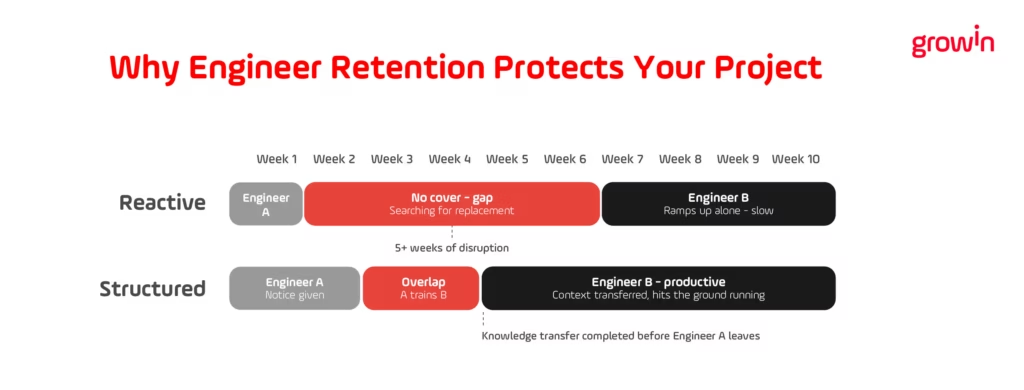
Turnover in nearshore is higher than in permanent employment — that’s a structural reality of the model, not a secret. Engineering attrition across European tech averages around 12% annually, but nearshore consultancy turnover tends to run higher given the nature of placed work. What separates good nearshore partners from average ones is not a perfect retention number — it is the trajectory, the practices behind it, and what happens when someone does leave.
At Growin, our nearshore turnover has come down significantly over the past 18 months, and currently sits below the industry benchmark for IT outsourcing. That improvement didn’t happen by accident — it came from deliberate investment in how we support placed engineers, and it directly benefits the clients those engineers work with.
The human relationship behind the retention number
Ask your prospective partner what they do, concretely, to maintain the relationship with placed engineers over the course of an engagement. Do they conduct regular one-to-ones with their people? Is there someone on the consultancy side whose responsibility it is to check in with the engineer — not just about project deliverables, but about how they’re feeling, whether they’re growing, and whether anything is creating friction?
A firm that treats placed engineers as a billing unit rather than as people it’s responsible for will have the retention numbers to match. A firm that invests in the human side of the relationship — career development, support structures, genuine two-way communication — tends to produce the kind of engineer loyalty that directly benefits your project.
What to ask when someone does leave
Even the best nearshore partners experience turnover. What matters is what happens next. How quickly can the firm identify a replacement? What does the knowledge transfer process look like? Who owns that transition — the client, or the partner? A firm that has a clear, practised answer to these questions is one that has thought seriously about protecting your project, not just filling a seat.
Question 3: Do You Have a Local Presence We Can Visit?
Physical presence changes the nature of the relationship
There is something that happens when a client visits a nearshore partner’s office that cannot be replicated on a video call. Meeting the team in person, seeing how the operation runs, understanding the environment the engineers work in — these things build a quality of trust that a contract alone cannot create. For a relationship that may run for several years, that foundation matters more than most clients anticipate before they’ve experienced it.
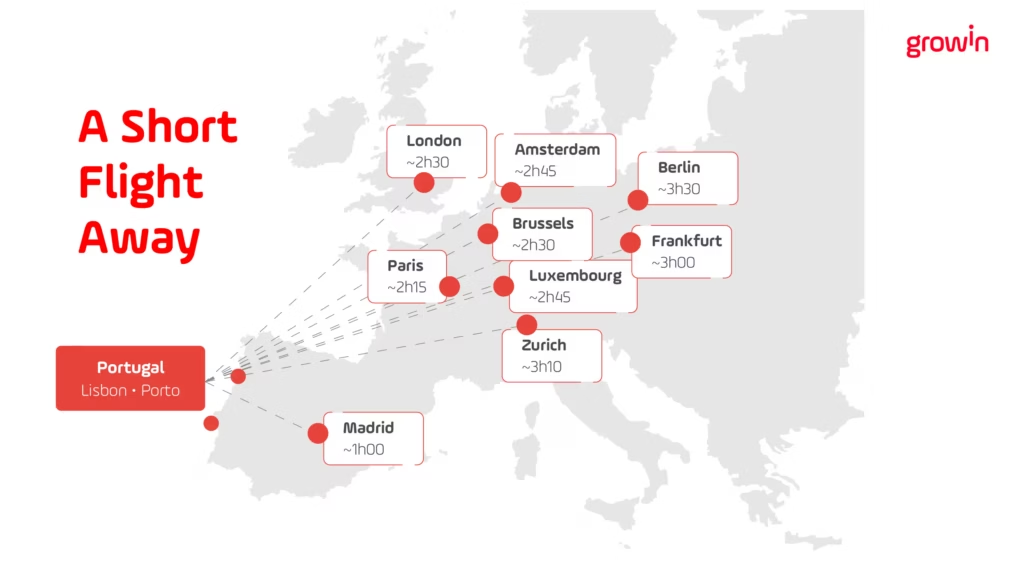
Ask whether the firm has a physical office, where it is, and how accessible it is. For European companies, Portugal offers a particularly practical answer to this question: Lisbon and Porto are both direct flights from most Western European capitals, with the whole country sitting within a two-hour timezone window of the UK, France, Germany, and the Netherlands (www.kwan.com/blog/top-nearshore-it-companies-in-portugal-lisbon-porto-2026-guide). A visit is not a significant logistical event — it’s an afternoon.
What a visit actually tells you
Visiting a nearshore partner’s office gives you visibility into things that don’t show up in a proposal. How is the workspace set up? Are the engineers clearly engaged and comfortable? Does the firm have an operations team — HR, account management, technical leadership — or is it essentially a sales front with a back-office somewhere else? Does the person who sold you the engagement still appear to be involved, or have you been handed off to someone you’ve never met?
Portugal’s tech sector grew 15% in 2025, with Lisbon and Porto both establishing themselves as genuine engineering hubs — Lisbon with the larger and more international talent pool, Porto with a strong university pipeline through FEUP and Universidade do Porto and excellent retention dynamics given its lower cost of living (www.edstellar.com/blog/skills-in-demand-in-portugal). A partner with a real presence in either city has real roots — and that accountability is something you can see for yourself.
Question 4: How Do You Handle Timezone Overlap and Day-to-Day Communication?
Timezone alignment is nearshore’s primary advantage — but only if it’s used
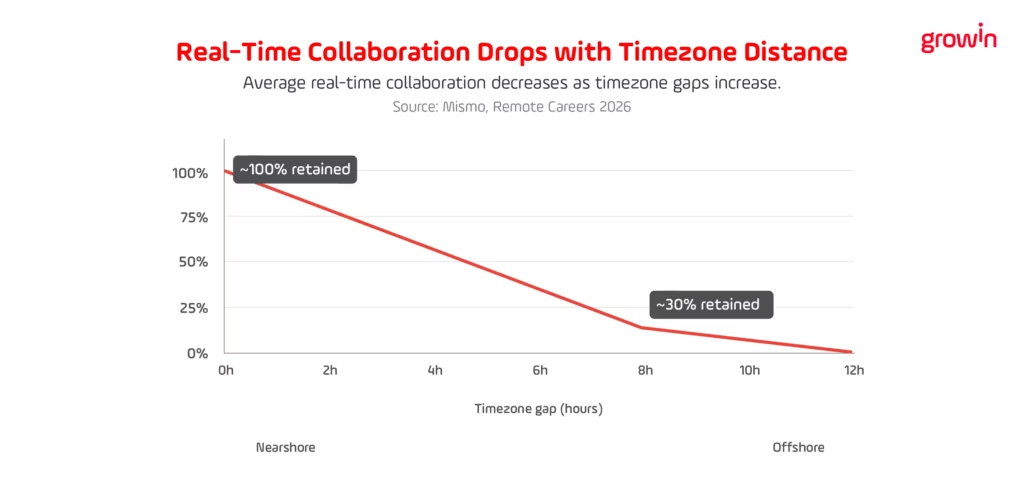
The reason nearshore consistently outperforms offshore on collaboration quality is timezone overlap. When both sides are working simultaneously, decisions get made the same day they arise, blockers get cleared in hours rather than overnight, and the working relationship feels like one team rather than two organisations passing work back and forth. That advantage is only real, however, if the nearshore partner’s working hours are structured to maximise it — not just nominally aligned but actually available during your core hours.
Ask specifically: what are the standard working hours for placed engineers? How does the firm handle urgent questions during the overlap window? What’s the expected response time for a message from your team during the working day?
Async communication as a capability, not a fallback
The best nearshore partnerships also have a mature approach to async communication — not because the timezone gap requires it, but because clear written communication is a professional discipline that prevents misunderstandings from building up over time. Ask how the firm approaches documentation, status updates, and decision records. A partner who can articulate a clear communication model — both for synchronous and async work — is a partner who has thought carefully about what distributed collaboration actually requires.
The overlap advantage in practice
For companies building iterative products where requirements shift and priorities evolve, same-day decision loops are not a nice-to-have. They are the operational difference between a team that moves with you and one that always seems to be half a cycle behind. When product managers, engineers, and technical leads can resolve a question before lunch, less work gets built on stale assumptions — and the cumulative effect of that, across months, is significant.
Question 5: How Do You Make Sure Both Sides Stay Aligned as the Engagement Evolves?
The relationship needs active maintenance
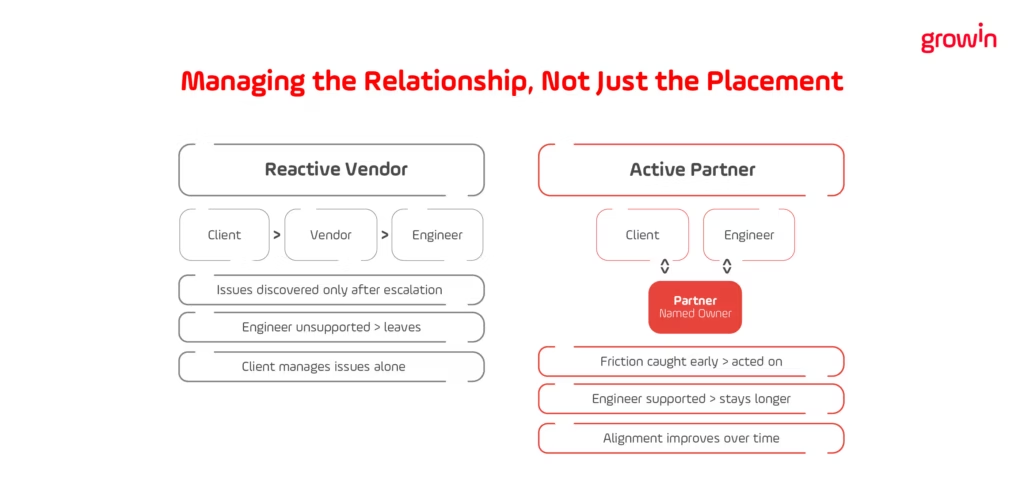
A nearshore engagement is not a one-time transaction. It is a working relationship that evolves — through project phases, team changes, shifting priorities, and the occasional friction that any real collaboration produces. The firms that manage this well don’t leave alignment to chance or assume that no news is good news. They have a structured approach to gathering feedback from both sides — the client and the engineer — and acting on it before small misalignments become real problems.
Ask what the check-in cadence looks like. How often does someone from the consultancy side speak with your team — not about deliverables, but about the health of the engagement itself? How often does someone check in with the placed engineer about how things are going from their perspective? And crucially — what happens when that feedback reveals something that needs to change?
Feedback flows in both directions
This is a point that often surprises clients: the engineer’s experience of the engagement matters to its outcome. An engineer who feels heard, supported, and genuinely part of your team performs differently from one who feels like a resource on loan. A good nearshore partner actively manages this — not by interfering in the day-to-day technical work, but by maintaining the relationship with their own people and ensuring that both sides feel the engagement is working.
What a structured approach looks like in practice
Look for partners who can describe a specific feedback model — regular touchpoints with named people on both sides, a clear process for raising concerns without escalation becoming a big event, and a track record of acting on what they hear. The firms that do this well tend to have long average client tenures, because the relationships compound rather than erode. A nearshore partner with multi-year client relationships is telling you something important about how they operate — and it’s worth asking about those relationships directly.
What Good Looks Like: Recognising the Right Partner
Signs you are talking to a genuine partner
The partner asks about your project before proposing a model. They describe their engineer wellbeing and retention practices in specific terms. They invite you to visit their office. They can tell you exactly how they handle the moments when something isn’t working, and they can point to long-running client relationships as evidence that those moments get resolved rather than escalated. They are transparent about what they are good at and honest about the kinds of engagements where a different model might serve you better.
A genuinely mature partner will also have thought about how their nearshore model scales as your engineering organisation evolves — whether that means growing a dedicated team, introducing intelligent automation to reduce manual overhead, or restructuring how responsibilities are distributed between in-house and nearshore engineers. The best nearshore relationships tend to grow in scope over time, because both sides have built the trust and the operating model to support it.
Signs the conversation is about closing a deal
The pitch is heavy on case studies and client logos and light on specifics. Questions about retention, engineer support, and feedback processes get vague or deflected answers. The proposal arrives before the partner has asked enough about your project to genuinely understand it. The emphasis is on speed to start and rate competitiveness rather than on fit and long-term outcome.
The difference between these two conversations is rarely subtle. A good nearshore partner is not trying to win a deal — they are trying to understand whether this engagement is one they can genuinely deliver on. That distinction, in practice, is the most reliable signal of all. For companies that have already invested in platform engineering or structured internal developer platforms, a nearshore partner who understands those models — and can integrate into them rather than around them — is a meaningful differentiator worth asking about specifically.
The Questions Are the Starting Point, Not the Finish Line
Asking the right questions before a nearshore engagement begins does not guarantee success. It does significantly improve the odds — and it changes the nature of the relationship from its first day. A partner who has been asked these questions, and answered them well, has already demonstrated something about how they operate: they are transparent, they have thought carefully about what makes an engagement work, and they are confident enough in their own delivery to welcome scrutiny.
Portugal’s position as one of Europe’s strongest nearshore engineering hubs — with over 262,000 ICT professionals, EU regulatory alignment, and direct access from every major Western European capital — means the talent and the infrastructure are genuinely there. The question is finding the partner that knows how to build on them.
If you’re evaluating a nearshore engagement and want to talk through what the right model might look like for your team, Growin’s team is happy to start that conversation without a pitch deck.